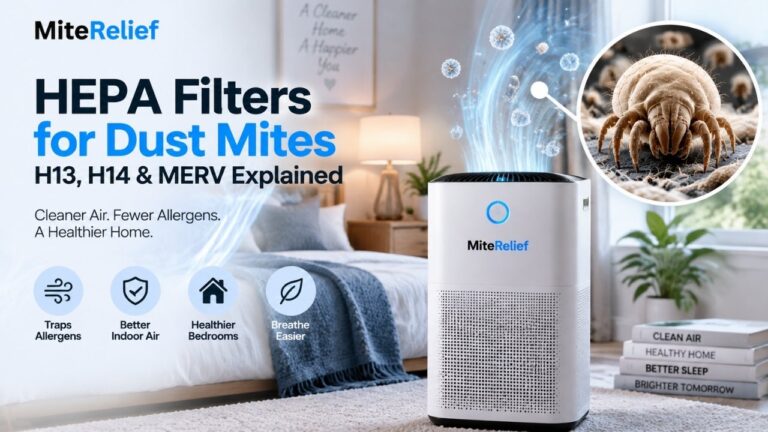
Dust mite allergies can make everyday life hard. Sneezing, itchy eyes, and a stuffy nose often get worse indoors. This is common in bedrooms. Many people try a HEPA filter for dust mites and hope it fixes the problem completely.
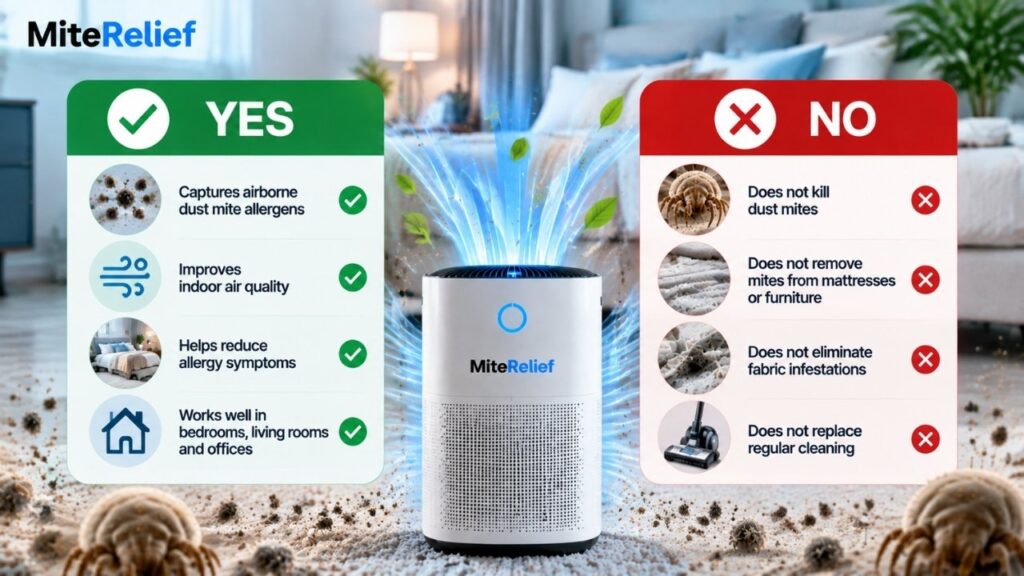
Here’s the truth. A HEPA filter does not kill dust mites in your mattress or furniture. But it does one important job. It traps airborne dust mite allergens floating in your home’s air.
That helps with symptoms, even if it’s not the whole fix. This guide explains how HEPA filtration works. It also covers what the ratings mean and where HEPA fits into a bigger allergen plan.
Understanding these details matters because not all “HEPA” products live up to the name. Some marketing labels borrow the word without meeting any real standard.
Knowing what to look for helps you choose filtration that actually improves indoor air quality, instead of paying extra for a label alone.
Do HEPA filters remove dust mite allergens?
Let’s clear up some confusion first. Dust mites and dust mite allergens are not the same thing.
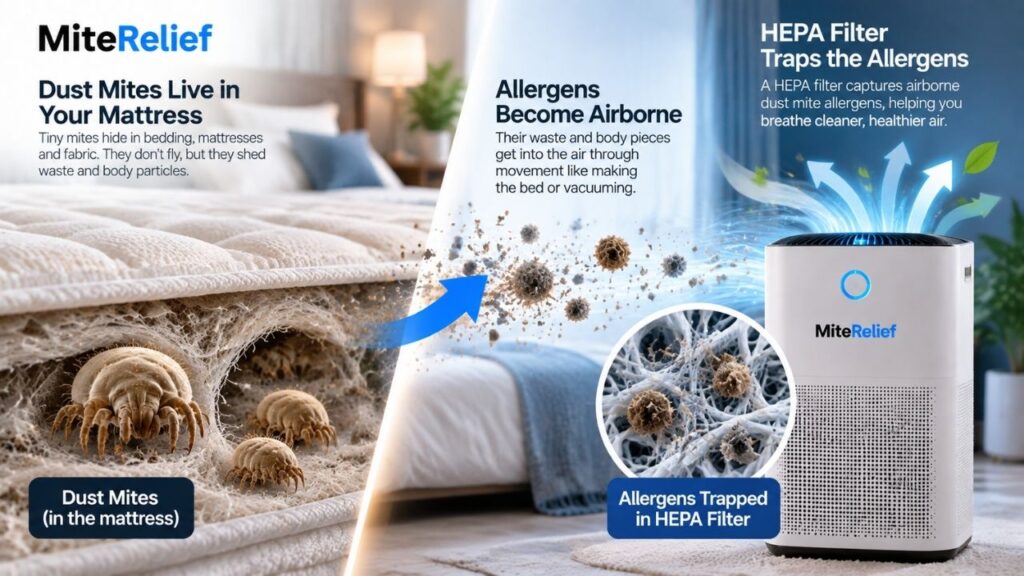
The house dust mite is a tiny creature. It lives in soft, warm places. Think bedding, mattresses, carpets, and couches. Mites do not fly or float through the air on their own.
But their waste and body pieces do get airborne. As mites shed, tiny particles break loose. Simple movement stirs them up. Shaking a pillow or vacuuming a rug can send them into the air. Once airborne, a HEPA filter can catch them.
These particles are surprisingly small and light. That’s why they stay suspended long enough for a person to breathe them in. A single bounce on the mattress or a gust from an air vent is often enough to lift them off the fabric.
Once they are floating, they can drift through a whole bedroom before settling back down. This is the window where a HEPA filter does its best work, since it can only capture particles while they are still moving through the air.
Here’s a simple breakdown:
| HEPA affects | Result |
| Airborne allergens | Captured |
| Dust mite bodies in air | May be captured |
| Mites inside mattress | Not removed |
| Fabric infestation | Not eliminated |
So the answer has two parts. Yes, HEPA filters help with dust mites. But they only trap the allergen particles mites leave behind. They do not hunt down the mites themselves.
How HEPA filtration captures dust mite allergen particles
A HEPA filter stands for High-Efficiency Particulate Air. It is not a simple screen with tiny holes. It is a thick mat of fine fibers packed in a maze. Airborne particles get trapped as air pushes through this maze. This happens in three ways.
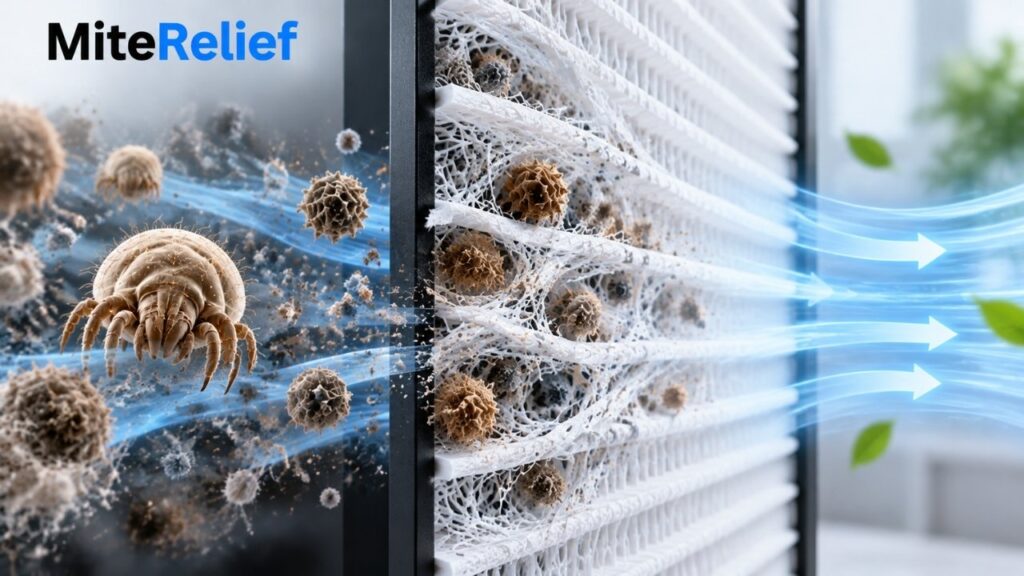
It helps to picture the fibers up close. They are packed together at random angles, not lined up neatly like a net. Air has to twist and turn to find a path through the mat.
Particles riding along in that air often cannot follow every turn. That mismatch between the air’s path and a particle’s path is really what makes filtration work.
Interception
Some particles follow the airstream closely. But they still brush against a fiber as they pass by. That small touch is enough to stop them. This is called interception. It mostly catches mid-sized particles.
Impaction
Bigger, heavier particles cannot turn fast enough. The air twists and bends, but the particle keeps going straight. It slams into a fiber and sticks. This is called impaction.
Diffusion
The smallest particles behave differently. They are often just a few microns wide. Instead of moving in a straight line, they bounce around at random. They bump into air molecules as they go. This random motion is called diffusion. It actually raises the chance that a tiny particle hits a fiber and gets trapped.
| Mechanism | How it works |
| Interception | Particle contacts fibers |
| Impaction | Particle hits fibers due to inertia |
| Diffusion | Random movement increases capture |
Together, these three steps let a true HEPA filter catch a wide range of particle sizes. That includes the tiny pieces that make up most dust mite allergens.
H13 vs H14 HEPA filters: what is the difference?
Not every filter labeled “HEPA” works the same way. True HEPA filters follow strict rules. The letter-number code tells you how strict those rules are.
H13 HEPA filters catch at least 99.95% of particles at their hardest-to-catch size. H14 HEPA filters go a step further. They catch at least 99.995%. Both count as true HEPA under most standards.
For home allergen control, this gap matters less than it sounds. H13 filters already remove most dust mite allergen particles from the air. H14 filters catch a bit more. But for someone with allergies, the real-world difference is often small.
| Rating | Efficiency | Dust mite allergen use |
| H13 | ≥99.95% | Suitable |
| H14 | ≥99.995% | Suitable |
| HEPA-type | Not standardized | Uncertain |
Watch out for labels like “HEPA-type” or “HEPA-like.” These terms are not regulated. They don’t guarantee the product meets true HEPA standards. If a label does not list a rating like H13 or H14, treat the claim with caution.
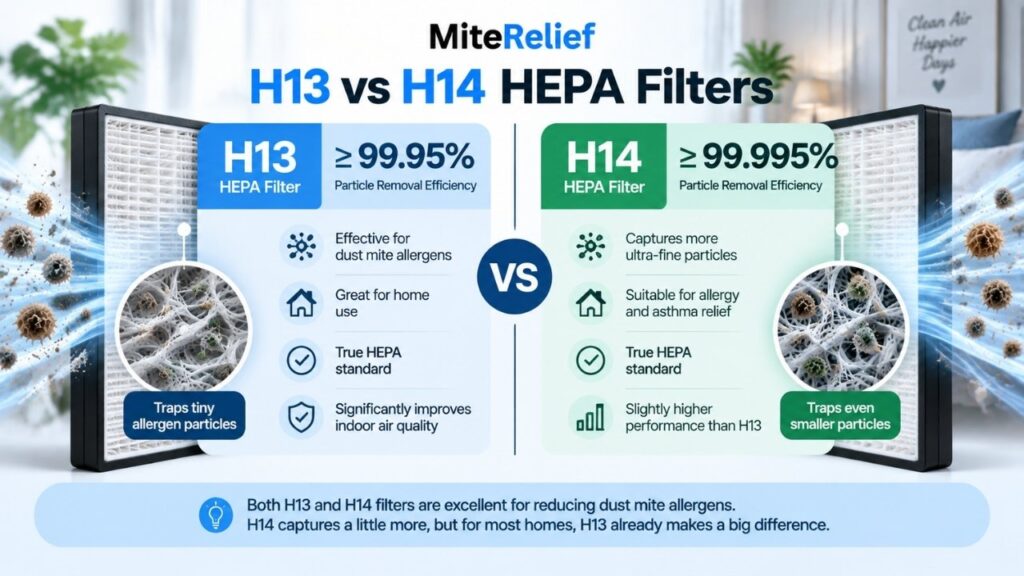
Check the product specs, not just the front of the box. A true HEPA filter should state its rating and the testing standard it meets. If a listing only says “HEPA quality” or “99% filtration” without a number tied to a recognized standard, dig a little deeper before you buy.
MERV ratings for HVAC dust mite filtration
HEPA usually refers to standalone filters. MERV rating, on the other hand, applies to filters in your home’s HVAC system. MERV stands for Minimum Efficiency Reporting Value. It runs from 1 to 20.
A higher MERV number means the filter catches smaller particles. But HEPA and MERV do not use the same scale. A true HEPA filter usually beats even a high-MERV furnace filter in raw efficiency.
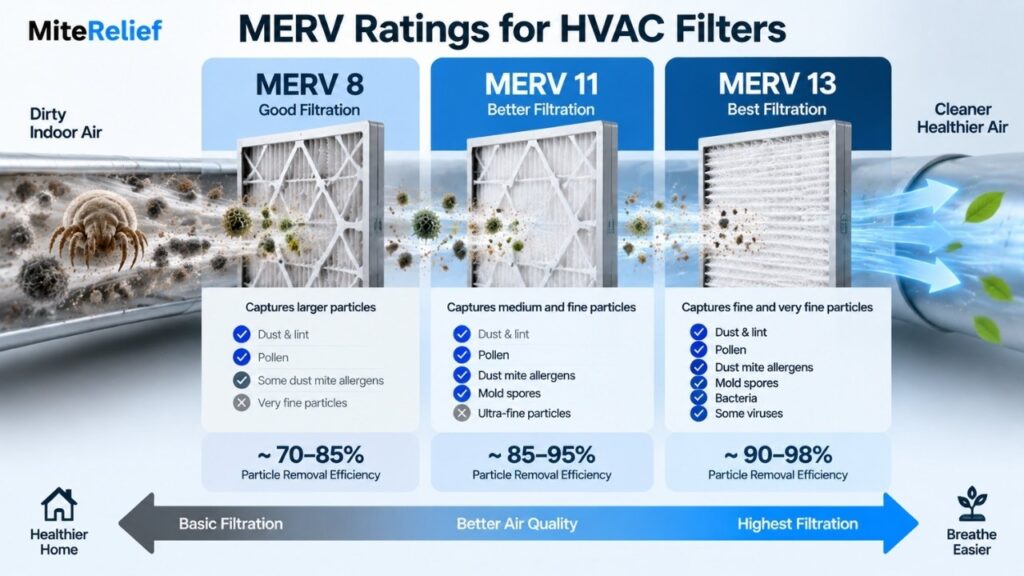
| MERV | Typical use | Dust mite allergen filtration |
| MERV 8 | Basic filtration | Limited |
| MERV 11–12 | Better filtration | Improved |
| MERV 13+ | Higher efficiency | Better for fine particles |
MERV 13 filters are often a good pick for allergy-sensitive homes. They balance strong particle capture with steady airflow in most home systems.
Why HVAC compatibility matters with high-MERV filters
Denser filters catch more particles. But they also block more airflow. A furnace built for a MERV 8 filter may struggle with a MERV 13 filter. The system was not designed for that added resistance.
Blocked airflow can strain your system. It can raise your energy bill. It can even shorten how long your equipment lasts. Before you upgrade, check your HVAC filter manufacturer’s guidance. Some systems handle MERV 13 just fine. Others need a technician to adjust for the extra resistance.
If you’re not sure what your system can handle, it’s worth a quick call to an HVAC technician before you buy a higher-rated filter. Jumping straight to the highest number on the shelf isn’t always the safest move. A filter that’s too dense for your blower can do more harm than good over time.
HEPA filters vs HEPA air purifiers vs HEPA vacuums
The word “HEPA” shows up on many products. That can get confusing fast. Each product filters air in a different place, for a different job.
| Type | Main function | Location |
| HEPA air purifier | Filters room air | Indoor air |
| HEPA vacuum | Captures particles during cleaning | Floors/furniture |
| HVAC filter | Filters circulated air | Whole home |
A HEPA air purifier pulls air from a room. It pushes that air through the filter. Then it releases cleaner air back into the room. It is built to run all day in one space, like a bedroom. To learn more about how air purifiers help with dust mite allergies, it helps to know they use the same particle-capture steps covered above. They are just built for a single room.
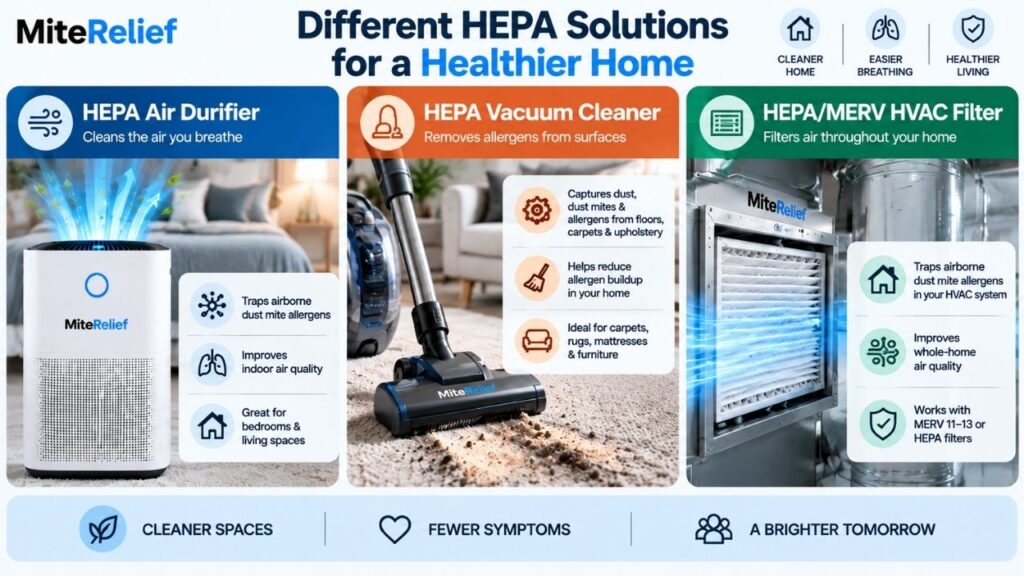
A HEPA vacuum works a bit differently. It traps particles kicked up while you clean. That stops them from resettling on your carpet or furniture right after.
An HVAC filter treats the air moving through your whole home’s ductwork. It covers more space. But it is also limited by what your system can handle, as noted above.
None of these three tools is automatically “better” than the others. They simply cover different jobs.
A household dealing with dust mite allergies often benefits most from combining two of them, such as an HVAC filter for whole-home air plus a HEPA air purifier running in the bedroom overnight.
How to maintain HEPA filtration effectiveness
A HEPA filter only works well if you keep it in good shape. Skipping upkeep is a common reason a filter seems to stop working.
How often you replace it depends on use. A filter running nonstop in a dusty home needs changing more often than one in a light-use space. Always check the manufacturer’s suggested timeline instead of guessing.
A clogged filter does not just filter less. It also blocks airflow, so the fan has to work harder. Watch for these warning signs:
- Weaker airflow from vents or the purifier
- Louder fan noise as the motor works harder
- Visible dust piling up on or around the filter
If you spot any of these signs, it is probably time for a new filter. This is true even if you are not sure of the exact install date.
Some people find it helpful to set a recurring reminder, like a calendar alert, instead of trying to remember on their own. A little routine maintenance goes a long way toward keeping filtration efficiency steady month after month.
What HEPA filters can and cannot do for dust mites
It helps to set fair expectations. HEPA filtration is a real, useful tool. But it is not a cure-all.
| HEPA can help with | HEPA cannot do |
| Capture airborne allergens | Kill dust mites |
| Reduce airborne particles | Remove mites from mattresses |
| Improve indoor air quality | Replace washing bedding |
| Reduce exposure during cleaning | Control humidity alone |
If you want to know methods that actually kill dust mites, that comes down to heat, sunlight, or specific cleaning steps, not air filtration. A HEPA filter simply cannot reach mites tucked inside a mattress or couch cushion.
For deeper cleaning, deep-cleaning a mattress for allergens covers a spot HEPA filtration never reaches.
Frequently Asked Questions (FAQs)
Can a HEPA filter trap dust mite allergens?
Yes. A true HEPA filter catches a very high share of airborne particles. That includes the tiny bits that come from dust mite waste and bodies.
Does HEPA remove dust mites from mattresses?
No. HEPA filters only clean the air. Dust mites living inside a mattress or piece of furniture stay put. You need to clean or treat those items directly.
What HEPA rating is best for dust mite allergies?
An H13 HEPA filter is usually enough for home allergen control. H14 offers a bit more efficiency. But the real-world gap for most homes is small.
Are MERV 13 filters effective for dust mite allergens?
MERV 13 filters can noticeably improve fine-particle filtration in your HVAC system. This works as long as your system can handle the added airflow resistance.
Can HEPA filtration replace dust mite prevention methods?
No. HEPA filtration works best alongside other steps, not in place of them. This includes dust mite prevention methods, using mattress encasements for dust mite control, and controlling humidity for dust mites. Each one targets a part of the problem that air filtration cannot reach.
What to read next
- Do Air Purifiers Help With Dust Mites?
- Best Vacuum Cleaners for Dust Mites?
- How to Prevent Dust Mites?
- How to Deep Clean a Mattress for Dust Mite Allergens
- Best Dehumidifiers for Dust Mite Allergy
Conclusion
A HEPA filter can meaningfully cut the airborne dust mite allergens floating through your home. That often means fewer triggered symptoms day to day. But it will not kill or remove the mites themselves from bedding, carpets, or furniture.
Think of HEPA filtration as one solid piece of a bigger plan. That plan also needs regular cleaning, dust-mite-friendly bedding choices, and humidity control. Used together, these steps go much further than any single tool on its own.
Medical Disclaimer
This content is for general informational purposes only and is not a substitute for professional medical advice, diagnosis, or treatment. Individual health needs can vary, so speak with a qualified healthcare professional about allergies, asthma, skin reactions, medications, or other symptoms. Seek prompt medical care if symptoms are severe, persistent, or getting worse.

Umar Farooq is the founder of MiteRelief, creating research-backed guides about dust mites, indoor allergens, and practical allergy prevention for healthier homes.