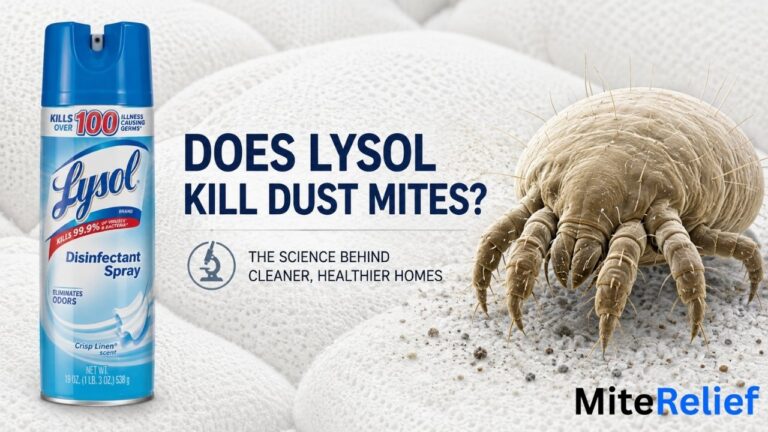
Does Lysol kill dust mites? Not exactly. Lysol is made to kill many kinds of bacteria and viruses.
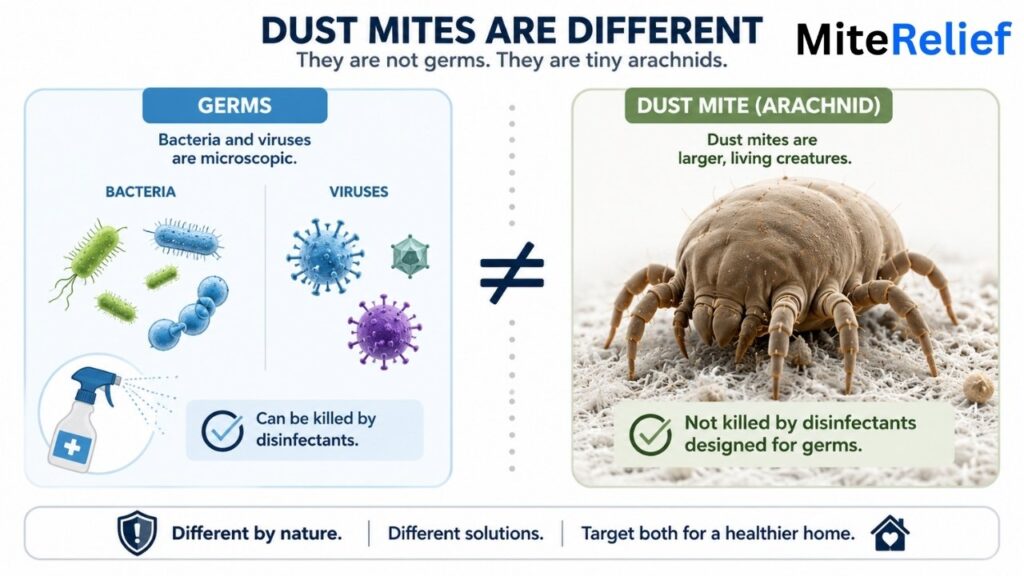
But that’s a different job than killing house dust mites. Dust mites aren’t germs.
They’re tiny, eight-legged arachnids. That difference matters a lot.
This article looks at what’s known about Lysol, bleach, rubbing alcohol, hydrogen peroxide, and other common products.
We’ll also cover something just as important. Even if a product kills mites, it may not remove the allergens they leave in your mattress or bedding.
Lysol is a disinfectant. It is not a proven mite killer. A disinfectant claim means a product can reduce the presence of certain bacteria or viruses.
It doesn’t mean it kills dust mites. Always check the label on your exact Lysol product. Bleach has stronger Support, but only under tested conditions.
It also comes with fabric and safety limits. And remember: killing mites and removing their allergens are two separate problems.
Does Lysol Kill Dust Mites?
Most Lysol products are labeled as disinfectants. That means they’re tested to kill certain bacteria and viruses.
This testing happens on hard surfaces or fabrics, depending on the product. Dust mites are something different. They’re arachnids with eight legs.
They are not single-celled germs. So a disinfectant claim doesn’t tell you much about how a product works against them.
Lysol’s active ingredients change from product to product. Some sprays use benzalkonium chloride.
This is a type of quaternary ammonium compound, often called a quat for short. Other sprays use ethanol, an alcohol.
These ingredients have antimicrobial properties. That means they can reduce certain germs.
But an antimicrobial ingredient doesn’t prove the finished spray kills dust mites. Lab tests on bacteria use different methods than tests on mites.
Here’s a key point. No major Lysol product currently has a specific, tested claim for killing house dust mites.
If you want to know what a product really does, check the label on the product you own. Products change over time.
Not every Lysol spray works the same way.
For methods with more direct Support, see our guide on what kills dust mites. It breaks down several tested options.
What Does the Label Say?
Product labels use specific words, and the differences matter. A disinfectant claim means a product kills certain germs on a surface.
A sanitizing claim is similar, but usually a weaker standard. An antimicrobial claim can cover many effects. It might mean slowing bacteria down, or fully killing it.
An acaricide, also called a miticide, is a different category. This product is tested and labeled to kill mites. Very few disinfectants carry this kind of label. Most Lysol sprays don’t have it either.
Before you spray anything on bedding or a mattress, check three things. Look at the exact active ingredients. Check which surfaces the label approves for use.
And check how long the product needs to sit, called the contact time. A product that’s safe on a hard surface may not be safe for soft, porous materials like a mattress.
Mites vs. Allergens
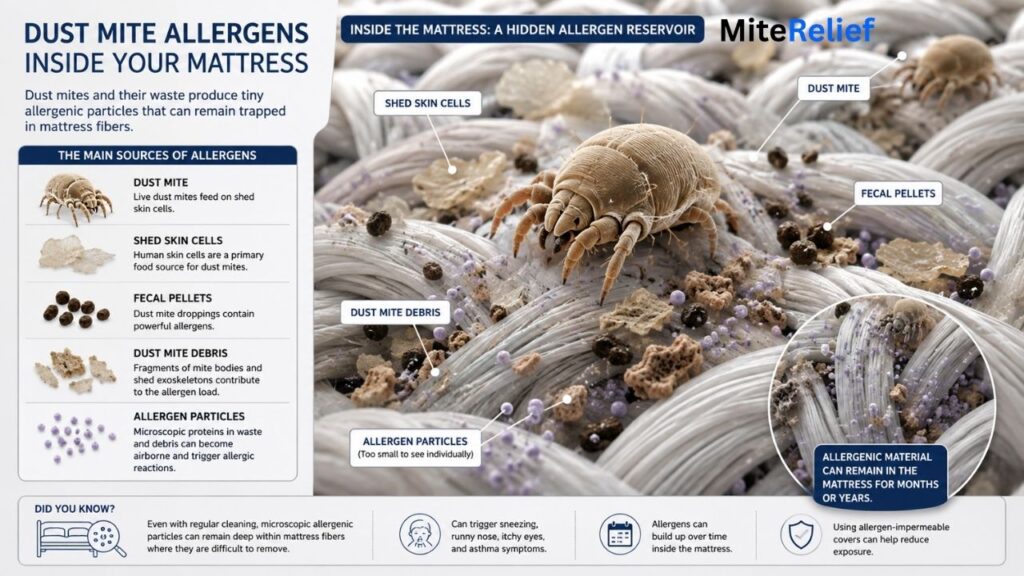
Here’s something that confuses a lot of people. Mite bites don’t cause dust mite allergy. Mites don’t bite at all.
It’s caused by proteins in their fecal pellets and body residues. These are the tiny bits mites leave behind as they live and die in your bedding.
That means killing a mite doesn’t solve the whole problem. A dead mite can still leave behind the same allergen proteins. These proteins trigger congestion or allergic reactions.
A treatment might do one of three things. It might kill mites. It might physically remove mite debris. Or it might directly affect the allergen proteins. Very few products do all three.
So even a disinfectant that kills mites on a surface may do little to remove allergens. If fewer allergy symptoms are your goal, other allergen-reduction steps still matter.
This is true even after a mite treatment. For more on how symptoms show up, see dust mite allergy symptoms.
Does Bleach Kill Dust Mites?
Bleach, or sodium hypochlorite, has more direct research than most chemicals on this list. Under laboratory testing conditions, bleach has been shown to kill dust mites.
That’s stronger Support than Lysol currently has.
But tested conditions doesn’t mean guaranteed results at home. Lab studies control the concentration, temperature, and exposure time. Your home won’t match those exact conditions.
Diluted bleach, used quickly on a mattress, isn’t the same as a controlled lab test.
Bleach may also affect the allergen proteins mites leave behind, though results vary by study. A few safety notes matter here.
Bleach can discolor or damage many fabrics, so check care labels first. Never mix bleach with other chemicals. The fumes can be dangerous.
And don’t spray bleach on a mattress just because it’s on hand. It’s not built for that kind of routine use.
Does Rubbing Alcohol Kill Dust Mites?
Rubbing alcohol, usually isopropyl alcohol, does have real antimicrobial properties. Some tested acaricide formulas include alcohol as one ingredient among several.
But that’s an important distinction. Support for a blended, lab-tested product can’t be credited to plain rubbing alcohol used alone.
There are also practical problems. Mattresses and upholstery are porous materials. That means liquids soak in rather than sitting on top.
Alcohol evaporates fast, often before it can do much good. It’s also flammable. That makes soaking a mattress in it a real safety risk, not just an ineffective idea.
Ethanol and isopropyl alcohol behave differently in different formulas. Neither one has strong, standalone Support as a dust mite treatment. Don’t soak fabric in rubbing alcohol expecting it to fix the problem.
Does Hydrogen Peroxide Kill Dust Mites?
Hydrogen peroxide is an oxidizing disinfectant. It kills germs through a chemical reaction, not through alcohol or quaternary ammonium compounds.
It’s often used to disinfect surfaces and wounds.
Its record against dust mites is thin. Killing bacteria and viruses doesn’t prove acaricidal action.
There isn’t strong published research showing that hydrogen peroxide reliably kills mites in bedding or on upholstery. It can also bleach or fade certain fabrics.
Test a hidden spot first if you plan to use it for any purpose.
Overall, hydrogen peroxide isn’t a well-supported method for dust mite control. Treat it as unproven for this specific job.
Does Febreze Kill Dust Mites?
Febreze is built around odor control, not mite control. Its products target smells. Some versions include allergen-reduction claims for specific triggers.
But odor control and allergen reduction aren’t the same as killing dust mites.
There’s no general support showing that standard Febreze sprays kill house dust mites.
If you use it on mattresses or bedding for freshness, that’s fine. Just don’t count on it as a mite treatment. Check the exact product’s label to see what it’s actually tested to do.
Dettol works similarly. It’s a well-known disinfectant brand, but claims vary depending on the exact formula and region.
Some Dettol products are labeled for germ control on surfaces. None are broadly sold as acaricides. As with Lysol, check the specific product you own.
Don’t assume the brand name guarantees mite-killing power.
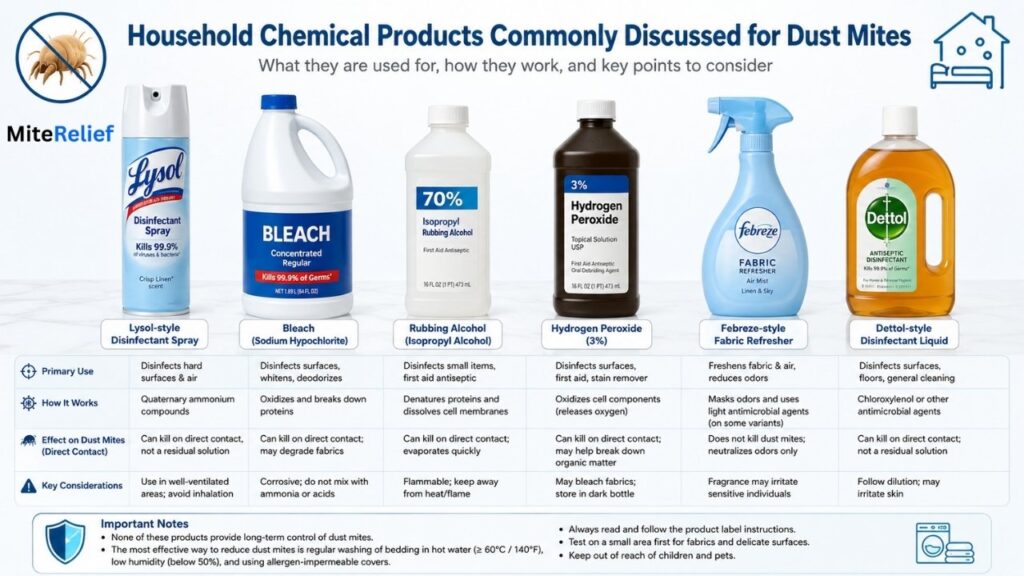
Products Compared
| Product | Evidence for Dust Mites | Main Limitation | Takeaway |
| Lysol | Not established from general disinfectant claims | Disinfecting isn’t the same as a mite claim | Check the exact label |
| Bleach | Direct evidence under tested conditions | Fabric damage and safety limits | Support exists, but use it carefully |
| Rubbing alcohol | Limited when used alone | Flammable and evaporates fast | Not a preferred mattress method |
| Hydrogen peroxide | Limited | Evidence and fabric-safety limits | Not a primary method |
| Febreze | Not generally tested as a miticide | Odor and allergen claims differ from mite claims | Don’t rely on it to kill mites |
| Dettol | Depends on the exact formula | Labels vary by product | Check the specific product |
What Works on Bedding?
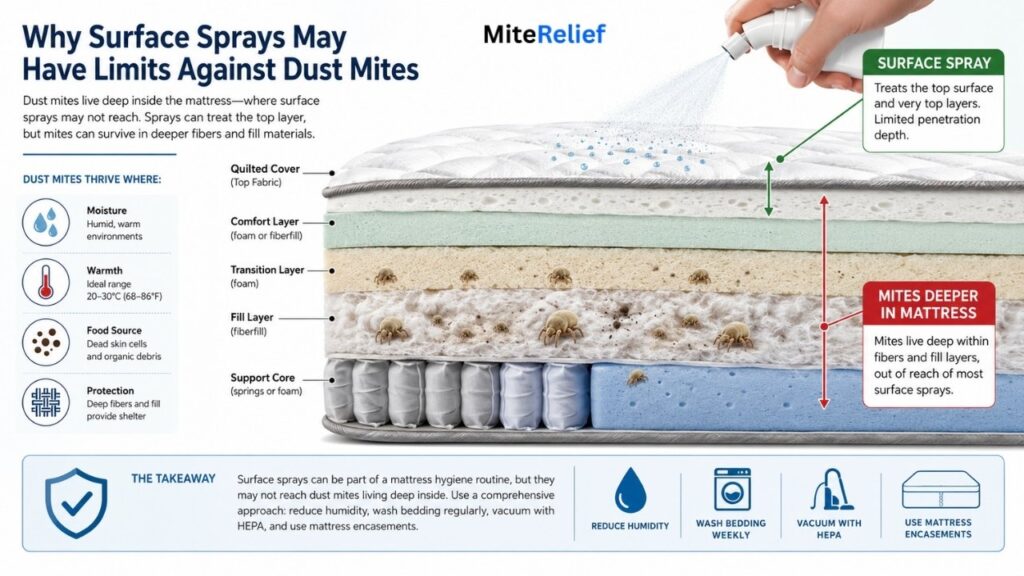
If your main goal is to reduce dust mites in your home, chemical sprays usually aren’t the most effective tool.
Hot water and a HEPA filter offer more solid Support than most sprays, and lower indoor humidity helps too.
Steam treatment is another well-supported option.
For guidance on washing, vacuuming, and other proven methods, see our guide to what kills dust mites, our guide to deep cleaning a mattress for dust mites, and our piece on whether steam cleaners kill dust mites.
Frequently Asked Questions (FAQs)
Can I spray Lysol on my mattress to kill dust mites?
Check your exact product’s label first. Not every Lysol spray is approved for mattresses or soft surfaces. Even where it is approved for fabric, there’s no proof it kills house dust mites. Treat it as a routine step, not a mite solution.
Does Lysol remove dust mite allergens?
Disinfecting a surface isn’t the same as removing allergen proteins or mite debris. Lysol may reduce certain germs. But removing allergens usually takes more direct steps, like laundering fabric or targeting dust head-on.
Does Dettol kill dust mites?
It depends on the exact formula, since Dettol products vary by region and version. No Dettol product is widely sold as a tested mite killer. Check your specific label for its real claims.
Can bleach kill dust mites in bedding?
Research suggests that bleach can kill dust mites under laboratory conditions. That’s stronger Support than most other products have. Still, follow fabric-care instructions closely, since bleach can damage or fade many types of bedding.
Does rubbing alcohol kill dust mites on a mattress?
Support for plain rubbing alcohol alone is limited. Mattresses are porous materials, so alcohol evaporates from them fast. It’s also flammable, so soaking a mattress in alcohol isn’t a safe or proven approach.
What to Read Next
- Do Steam Cleaners Kill Dust Mites? Does UV Work?
- How to Deep Clean a Mattress for Dust Mites
- How to Prevent Dust Mites: 9 Habits That Actually Work
Conclusion
Lysol can handle plenty of germs. But killing dust mites isn’t a claim most of its products back up. Bleach has the strongest direct Support of the group.
Rubbing alcohol, hydrogen peroxide, Febreze, and Dettol all lack solid, mite-specific evidence. No matter which product you reach for, remember this killing mites and clearing out their allergens are two different jobs. Real allergy relief usually takes more than a spray on its own.
Medical Disclaimer
This content is for general informational purposes only and is not a substitute for professional medical advice, diagnosis, or treatment. Individual health needs can vary, so speak with a qualified healthcare professional about allergies, asthma, skin reactions, medications, or other symptoms. Seek prompt medical care if symptoms are severe, persistent, or getting worse.

Umar Farooq is the founder of MiteRelief, a resource for dust mite control and allergy prevention. After battling allergen sensitivity, he started creating research-backed guides that turn complex indoor air quality science into practical, affordable solutions anyone can implement.