Picture someone who has never had a single allergy. Then, almost overnight, they wake up sneezing with a blocked nose. Naturally, they ask: can dust mite allergies develop suddenly? They can. A dust mite allergy may show up in adulthood, even if you felt perfectly fine for years.
In some cases, your immune system has only just become sensitive. In others, a rise in allergen exposure brings out a sensitivity that was already there. Below, both ideas are explained in simple terms. This guide is for learning only. It cannot stand in for a healthcare professional’s advice.
Can You Develop Dust Mite Allergy as an Adult?
Yes, it can happen. Allergies can start at nearly any age. Some people react as children, while others first see an adult-onset allergy in their 20s, 30s, or even later.
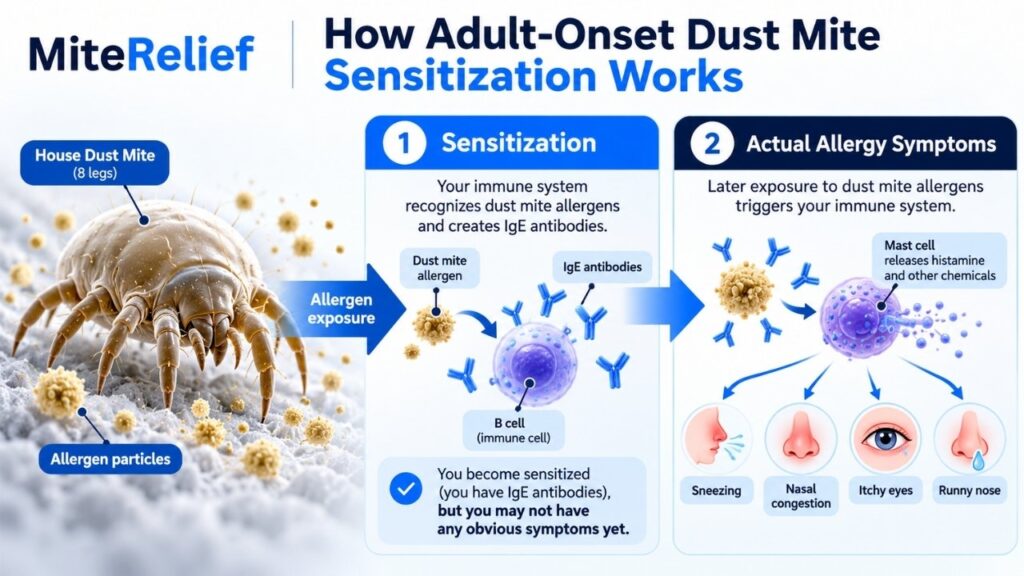
Your immune system exists to guard you against germs. In an allergy, it mistakes something harmless for a danger. With a dust mite allergy, the trigger is dust mite allergens. These are very small proteins that come from the bodies and droppings of the house dust mite.
The first stage is known as sensitization. Here, your body builds IgE antibodies aimed at dust mite allergens. You can be sensitized and still feel normal. An allergic reaction only occurs when your immune response also brings on symptoms.
That is why a clean childhood record does not rule out a new problem. Allergy symptoms appearing later in life are real, and they are not unusual.
Why Do Dust Mite Allergies Suddenly Appear?
Many people wonder, “why do I suddenly have a dust mite allergy?” Often, the allergy was not truly sudden. It may have been growing quietly, or something in your life shifted. Doctors cannot always pinpoint the cause for one person.
These are the main possibilities:
- Changes in exposure. A bigger load of dust mite allergens in the air may push you over your “symptom threshold.”
- Different living conditions. A new bedroom, fresh bedding, or a damp room can alter how much allergen reaches your lungs.
- Individual immune sensitivity. Some people’s immune systems simply react faster than others.
- Environmental factors. Dust mites usually thrive in damp air, so high humidity in your home may increase allergen levels.
Dust mites tend to gather in the bedroom, where you spend many hours every night. This may explain why symptoms often feel stronger at night or right after you wake. For more, see dust mite exposure in bedrooms on MiteRelief.
Can Moving to a New Home Trigger Allergy Symptoms?

It can change how much you are exposed to. A new place may come with older mattresses, carpet, or upholstered furniture that hold extra dust mite allergens. A damp basement or a stuffy bedroom can make things worse.
That said, a move does not always create a new allergy. Many times, the person was already sensitized, and the new home just brought more allergen. In other cases, the cause is something else, like a different allergy or an irritant.
New Allergy or Previously Unnoticed Sensitivity?
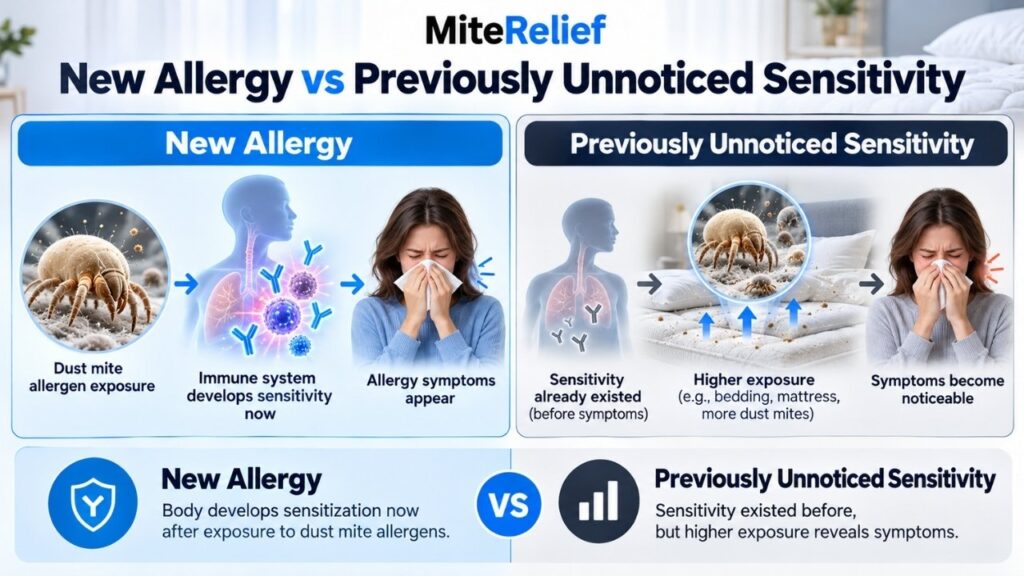
These two ideas sound similar, yet they are not the same.
A new sensitization means your body has only now begun making IgE antibodies to dust mite allergens. A previously unnoticed sensitivity means the antibodies were already present. You simply never had symptoms because your exposure was low.
Then something shifts. You move, buy a new couch, or start spending more time at home. The added exposure lets the old sensitivity turn into symptoms.
Typical signs are sneezing, nasal congestion, a runny nose, itchy eyes, and postnasal drip. Doctors call this pattern allergic rhinitis. For the complete list, check these common dust mite allergy symptoms.
| Situation | Why Symptoms May Appear |
| New sensitization | The immune system develops sensitivity to dust mite allergens |
| Increased exposure | An existing sensitivity becomes noticeable after greater exposure |
| Environmental changes | Moving or changes in indoor conditions may affect symptoms |
| Other conditions | Irritants, infections, or other allergies can cause similar symptoms |
One point matters most. Symptoms by themselves cannot confirm a dust mite allergy. Colds, other allergies, and irritants can look just like it.
Does Family History Increase Your Risk?
It can. A family history of allergies makes it more likely that you will become allergic. This is known as genetic predisposition, which means you may inherit a tendency to react to allergens.
This pattern shows up often in families with allergic rhinitis, asthma, or eczema. If your parents or siblings have any of these, your own risk may be higher.
Still, family history does not guarantee anything. Some people with allergic relatives never become allergic, and some with no family history do. Genes and environmental factors both appear to play a role.
How to Confirm a New Dust Mite Allergy

Try not to guess. An allergist can help you work out what is happening. A visit usually begins with your medical history and the times your symptoms occur.
After that, you may go through allergy testing. A skin prick test looks at how your skin reacts to tiny amounts of allergen. A specific IgE blood test checks your blood for dust mite antibodies.
A positive result points to sensitization, but it does not always prove dust mites are behind your symptoms. Your allergist will weigh the results alongside your symptoms and history. For more detail, read about how dust mite allergy is diagnosed.
Does Adult-Onset Dust Mite Allergy Get Worse?
Not necessarily. Adult-onset dust mite allergy may stay steady, improve, or get worse. It depends on the person and how much allergen is around them.
The long-term prognosis differs from person to person. Many people keep their symptoms under control with a doctor’s help. Untreated allergies do not always lead to asthma, but talk to a doctor if you notice wheezing or chest tightness.
If symptoms keep coming back, a doctor may bring up allergen immunotherapy. This treatment can help the immune system react less over time. Our guide on immunotherapy for dust mite allergy has more.
Can Symptoms Improve or Change Over Time?
Yes. Symptoms may become more or less frequent as your life changes. A drier home, new bedding, or a move can alter your exposure, and your body’s response can shift with age.
Results vary from one adult to the next. Some people get better on their own, though that is never certain. This is why steady medical care matters if symptoms continue.
What to Do When Dust Mite Allergy Appears Suddenly
Try these simple steps:
- Track your pattern. Write down when and where symptoms begin. Are they worse in bed or after cleaning?
- Think about what changed. Have you moved, bought new furniture, or spotted a damp room?
- See a doctor if symptoms last. Ask whether an allergist is right for you.
- Talk about symptom relief. Your doctor can suggest what suits you. Never change medicines or doses on your own.
- Lower exposure where you can. These ways to reduce dust mite exposure are a good place to start.
Changes at home can help, yet they do not replace medical care. They also cannot remove an allergy for good.
Seek urgent medical care immediately if you have severe trouble breathing.
Frequently Asked Questions (FAQs)
Can dust mite allergies develop suddenly at any age?
Dust mite allergy can begin or become noticeable during adulthood. Being older does not protect you. It may feel sudden even if it built up slowly.
Why do I have dust mite allergy symptoms now when I never did before?
You could have a new sensitization. You could also have an older sensitivity that extra exposure has made easier to notice. Other conditions can cause the same symptoms, so testing is useful.
Can moving to a new house trigger dust mite allergy symptoms?
It can change how much allergen you come into contact with, which may bring on symptoms. It does not prove the move created a new allergy.
Can a viral illness cause a new dust mite allergy?
A clear link has not been shown. A cold can resemble an allergy, so the two are hard to tell apart. If symptoms last, get checked.
Can adult-onset dust mite allergy go away on its own?
It varies. Some people improve with time, but that is not guaranteed. A doctor can help you make a plan.
How long does it take to develop dust mite allergy?
No fixed timeline exists. It differs from one person to another.
What to Read Next
Conclusion
Dust mite allergy can develop, or simply become noticeable, in adulthood. New sensitization, shifting exposure, and family history may all contribute. If your symptoms last, talk to a healthcare professional rather than assuming dust mites are to blame. A proper evaluation gives you a clear answer and a stronger plan.
Medical Disclaimer
This content is for general informational purposes only and is not a substitute for professional medical advice, diagnosis, or treatment. Individual health needs can vary, so speak with a qualified healthcare professional about allergies, asthma, skin reactions, medications, or other symptoms. Seek prompt medical care if symptoms are severe, persistent, or getting worse.

Umar Farooq is the founder of MiteRelief, creating research-backed guides about dust mites, indoor allergens, and practical allergy prevention for healthier homes.