Does your eczema flare up out of nowhere? An indoor allergen might be part of the reason.
Eczema from dust mites is a real possibility for some people.
This is especially true for people with atopic dermatitis who also react to house dust mites.
But mites are not the only cause. A flare by itself does not prove they are behind it.
Sensitization and skin barrier problems both play a role. Symptoms alone cannot tell you what is triggering your skin.
This article looks at how mites may affect eczema-prone skin. It also covers how to spot patterns and what management can look like.
This article is for general information.It is not a substitute for medical advice. Talk to a dermatologist or allergist about your specific symptoms.
Can Dust Mites Cause Eczema?
House dust mites do not cause eczema in everyone. For most people, exposure to mites does not cause any skin problems at all.
But for some people with atopic dermatitis, mites can act as a trigger. They may make existing eczema worse.
So, can dust mites cause eczema? Not by themselves.
They don’t directly cause eczema in everyone, but house dust mites and eczema can be connected in people who are sensitive to mite allergens, especially those with atopic dermatitis.
Here is an important point. Sensitization does not always mean you will have symptoms. You can test positive for a dust mite allergy and never notice it on your skin.
Your immune response to mites is just one piece of a much bigger picture.
Dust Mites Are a Trigger, Not the Only Cause
Eczema is a complex condition. Genetics play a role. So does a weak skin barrier and dry skin. Many everyday things can also set off a flare.
People sometimes describe this as eczema caused by dust mites, but mite allergens are better understood as a possible trigger rather than the only cause of eczema.
Heat and sweat are common triggers. So is fragrance in lotions or laundry soap.
Other irritants can cause problems too, and so can skin infections. Environmental factors like pollen, mold, or pet dander can add to the mix.
Dust mites may add to flares in people who are sensitive to them. But they are just one possible trigger among many.
Managing exposure can help, but it’s important to remember that eczema often has multiple causes. Keep this in mind to feel more empowered and less overwhelmed.
How Dust Mite Allergens Affect the Skin Barrier
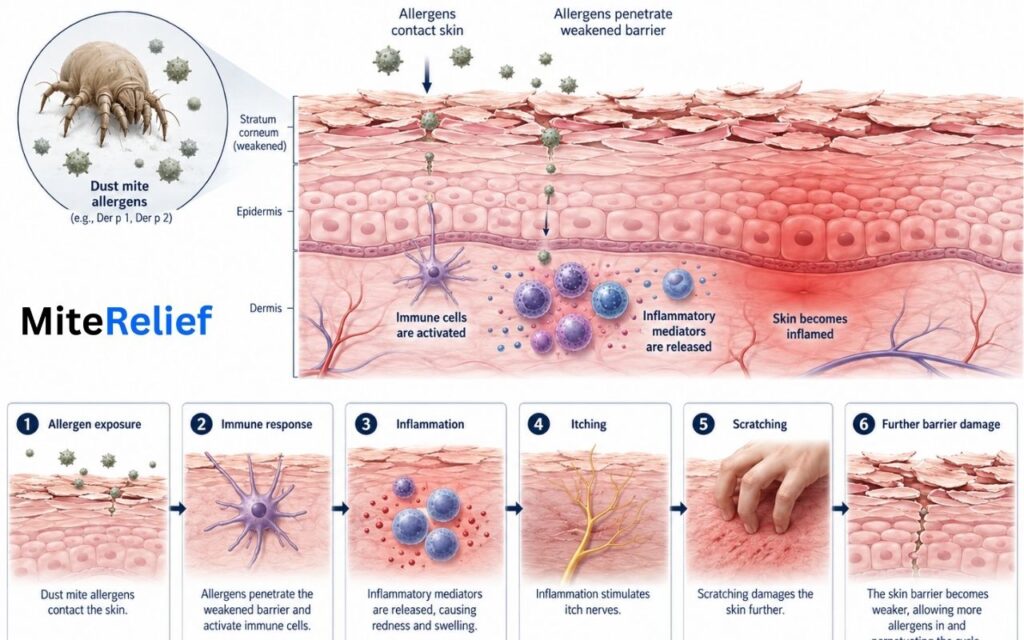
Your skin barrier is the outer layer of your skin. It keeps moisture in and keeps irritants out.
When this barrier is weak, small particles, such as mite allergens, can pass through more easily.
Once allergens get past the barrier, your body may react. The immune response can lead to inflammation and itching.
Scratching feels good in the moment, but it damages the barrier even more. This lets in more allergens and irritants, and the cycle continues.
When dust-mite allergens are among the triggers, this itch-scratch cycle can further weaken eczema-prone skin.
Two mite proteins come up a lot in research. They are called Der p1 and Der p2. Der p 1 and Der p2 are two major house dust mite allergens.
Der p 1 has enzyme activity that can weaken barrier proteins, while Der p 2 can help activate allergic immune responses.
They help explain why mite exposure matters more for some people than others.
Why Eczema-Prone Skin Is More Vulnerable
Skin that already has eczema damage lets allergens and irritants in more easily. That is simply how a weak barrier works.
Scratching makes things worse. Each scratch can create tiny breaks in the skin. These breaks give allergens, irritants, and even bacteria more chances to get in.
Filaggrin is a protein that helps build and hold together the skin barrier. In some people with eczema, filaggrin does not function properly.
This may make the skin react more to allergens like dust mites. Scientists are still studying how much this matters for any one person.
How to Tell if Dust Mites Are Triggering Your Eczema
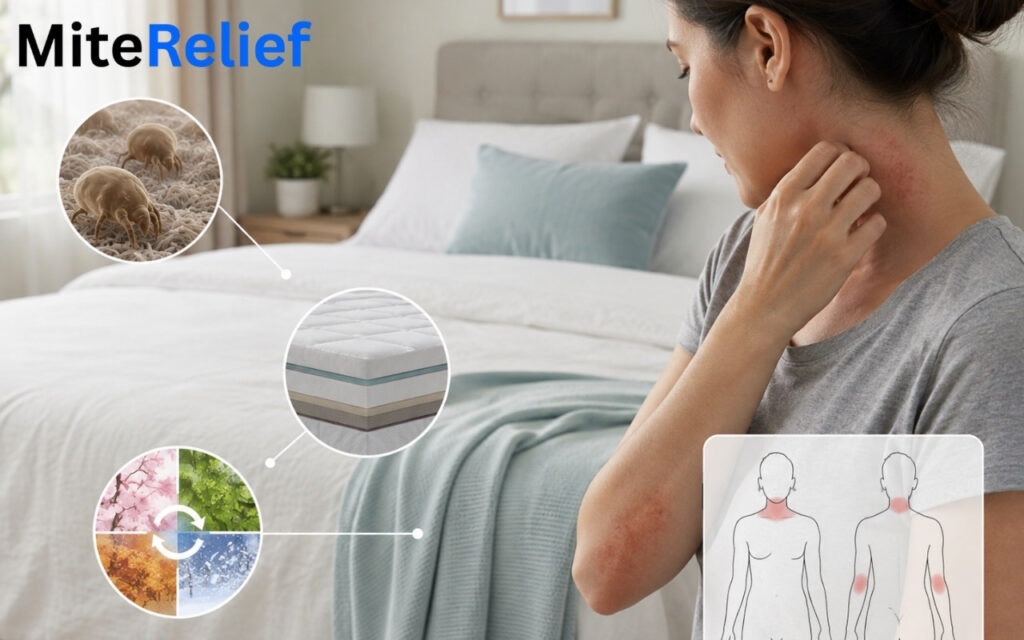
Some signs, like worse flares after bed or year-round symptoms, can suggest mite involvement. Noticing these patterns helps you discuss triggers with your doctor.
Other allergy symptoms at the same time can be another clue. A stuffy nose or itchy eyes are common examples.
A known dust mite allergy from a past test can help you and your healthcare provider better understand your triggers, fostering confidence in your management plan.
None of these signs prove that dust mites are causing your eczema flare. They are patterns to bring up with a doctor. They are not a diagnosis you can make on your own.
| Possible Pattern | What It May Suggest |
| Flares seem worse around bedding | Bedroom exposure may be worth checking into |
| Symptoms improve away from home | A home trigger may be involved |
| Eczema occurs throughout the year | Indoor allergens may be relevant |
| Other allergy symptoms occur too | An allergy check-up may help |
| Positive dust mite allergy test | Shows sensitization, not proof mites cause eczema |
Positive dust mite allergy test Shows sensitization, not proof mites cause eczema
How Doctors Check Whether Dust Mites Are a Trigger

A dermatologist or allergist usually starts by asking about your health history. They will ask about your eczema pattern. They will also ask when flares happen and what you are exposed to at home and at work.
A physical exam helps them see where and how your skin is affected. From there, allergy testing may come into play if it is appropriate for your case.
Here is a point worth repeating. A positive allergy test shows sensitization. It does not, on its own, prove that dust mites are causing your eczema.
Your doctor will consider your test results along with your history and exam to help you feel supported and confident in your treatment plan.
Skin Prick Testing
A skin prick test involves placing a tiny amount of allergen on your skin to check for a reaction. It is quick, but it only shows sensitization. It does not confirm a cause.
Specific IgE Blood Testing
A specific IgE blood test checks your blood for antibodies related to dust mites. Like skin testing, it points to sensitization.
It does not guarantee a diagnosis on its own.
Want more detail on how these tests work? See our full guide to dust mite allergy testing.
Managing Eczema From Dust Mites
Managing eczema linked to dust mites usually means mixing general skin care with attention to allergen exposure. There is no single fix that works the same way for everyone.
Protect the Skin Barrier
Regular moisturizing is one of the simplest things you can do for eczema-prone skin. Gentle skin care helps too. So does avoiding anything that irritates your skin without good reason.
Manage Active Flares With Medical Guidance
Treatment for an active flare depends on a few things. Your age matters. So does how bad the flare is, where it is on your body, and your medical history.
A dermatologist can suggest an approach that fits you. For an overview of potential options, see our guide to dust mite allergy treatment.
Reduce Relevant Dust Mite Exposure
When dust mites are a confirmed or likely trigger, reducing exposure may be one part of a broader dust mite eczema treatment plan.
It should support regular skin care and medical treatment rather than replace them. For more on caring for irritated skin day-to-day, see our guide to dust-mite skin treatment.
Skin Barrier Care for Dust Mite-Triggered Eczema
Whether dust mites are a confirmed trigger or not, good skin barrier care helps almost anyone with eczema. A few habits can make a real difference over time.
Moisturizing and Gentle Skin Care
Using a moisturizer or emollient regularly helps retain moisture in your skin. This supports the barrier. Gentle bathing also helps.
Use lukewarm water instead of hot water to protect dry skin and sensitive skin from more damage.
Avoiding Irritants That Can Worsen Flares
Fragrances, harsh soaps, and strong cleansers can all worsen sensitive skin. Overheating and sweat can also contribute to the problem. Wearing loose, breathable layers may help if this applies to you.
Reducing Dust Mite Exposure When You Have Eczema

If dust mites seem to be a real trigger for your eczema, a few targeted steps can help. Exposure to mattresses and pillows tends to matter most. This is because mites gather there in large numbers.
If dust mites appear to be a relevant trigger, targeted steps may include allergen-proof bedding covers, regular bedding washing, and managing indoor humidity.
These measures may reduce exposure, but they do not replace standard eczema care. Our guide to dust mite mattress encasement covers what to look for.
Our guide to reducing dust mite exposure at home takes a more comprehensive approach.
Eczema in Children and Dust Mites
Children with atopic dermatitis can also show sensitization to dust mites, just like adults do. A positive test does not mean every flare your child has is caused by mites.
Skin care and treatment for kids should be age-appropriate. Children’s skin and immune systems are not the same as adults’.
Parents are best served by following guidance from a pediatrician, dermatologist, or allergist. This is better than guessing at a cause on your own.
Frequently Asked Questions
Can eczema be caused by dust mites alone?
No. Eczema usually has more than one cause. Genetics, skin barrier problems, and other environmental triggers all play a part. Dust mites may add to the picture for some people, but they are rarely the only cause.
Can dust mite allergy make eczema worse?
Yes, in people who are sensitized. If you have an eczema dust mite allergy, exposure to mite allergens may add to your flares. The effect is different for each person.
How quickly can eczema improve after reducing dust mite exposure?
There is no set timeframe; it varies widely from person to person. Cutting back on dust mite exposure does not help everyone equally, since mites may not be a major trigger in every case.
Can you have eczema without being allergic to dust mites?
Yes. Dust mites are just one of many possible eczema triggers. Plenty of people with eczema have no mite allergy at all.
Can immunotherapy help with dust mite-related eczema?
It may help some people who have confirmed dust mite sensitization. But it is not a standard eczema treatment on its own. An allergist or dermatologist can tell you if it is worth looking into for your case.
What to Read Next
- Dust Mite Rash & Skin Treatment
- Dust Mite Allergy Test: What to Expect at the Doctor
- Dust Mite Mattress Encasement
- Best Allergy Medicine for Dust Mites
- How to Prevent Dust Mites
Conclusion
Dust mites can be one of several triggers for eczema. This is especially true for people who are sensitized and have a weak skin barrier.
Flare patterns alone do not prove that mites are the cause. A medical checkup can help sort out what is really going on.
From there, good skin care and relevant exposure reduction can work together. Together, they can support calmer, healthier skin.
Medical Disclaimer
This content is for general informational purposes only and is not a substitute for professional medical advice, diagnosis, or treatment. Individual health needs can vary, so speak with a qualified healthcare professional about allergies, asthma, skin reactions, medications, or other symptoms. Seek prompt medical care if symptoms are severe, persistent, or getting worse.

Umar Farooq is the founder of MiteRelief, a resource for dust mite control and allergy prevention. After battling allergen sensitivity, he started creating research-backed guides that turn complex indoor air quality science into practical, affordable solutions anyone can implement.