Yes, it can. Researchers have detected house dust mites and their allergens in areas where dogs spend much of their time indoors, including dog bedding. Still, that doesn’t mean every bed has live mites.
Whether a dog bed shelters dust mites depends on three things: what the bed is made of, how damp the air in your home gets, and how often you wash the bed.
This guide explains how allergens build up in pet bedding, how to clean covers and foam inserts safely, and when a bed is worth replacing.
Can Dust Mites Live in Dog and Cat Beds?
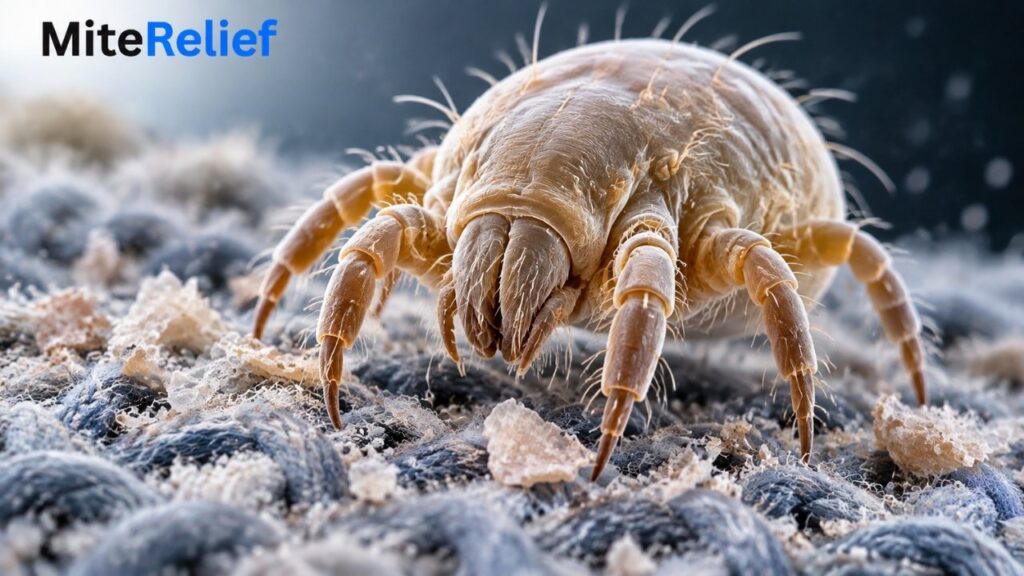
They can, under the right conditions. Dust mites are microscopic, and they live on shed skin and other fine debris. Pets shed fur and tiny skin particles constantly, and many settle where animals nap. Mixed with everyday household dust, that can give mites something to feed on.
Dry air is hard on mites. That is why humidity matters, and you can read more in our article on how humidity affects dust mite survival. In dust mite research in dogs, Ohio researchers collected dust from the places dogs favored in 50 homes.
Allergen turned up in every home, while living mites were found in just 15. Where mite counts and allergen levels were highest, the indoor air had also reached more than 75% relative humidity at some point.
Don’t confuse the mite with its allergen. Mite allergens are proteins. Mites shed them with their bodies and droppings, and they can linger in dust long after the mites are gone.
A separate UK team collected dust from pet dogs and from their beds. Only a portion of those samples contained mites. Both studies covered a limited set of homes, so neither can predict what your dog’s bed holds.
A bed used for years has had more chances to collect dust, so that age may be one factor. Still, no research sets a replacement date, and age alone does not make a bed infested.
Can Pet Beds Increase Allergen Exposure for People?
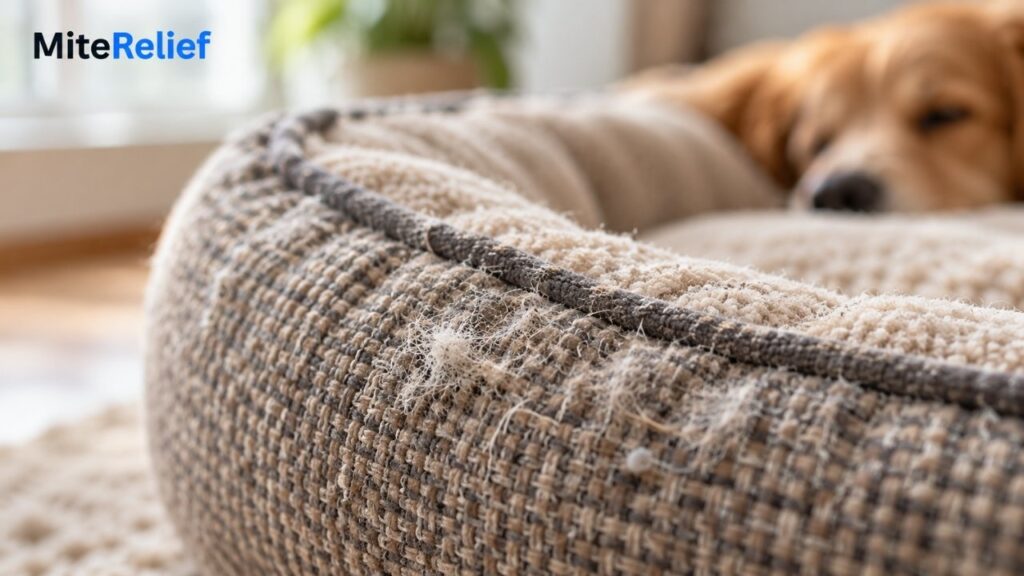
They can increase it, especially for people sensitive to dust mites. Shaking out a bed, dragging it across the floor, or a dog jumping in can send dust into the air. If the bed sits in your bedroom or beside the couch, you may breathe in more of it.
Dust mite allergens come from the mites. Dander comes from your pet. Both can be in one bed, and either can trigger similar reactions.
Researchers have also found mite allergens on dogs’ skin and coat, so that a dog may bring them to its bed.
Symptoms alone cannot tell you where your exposure comes from. A pet bed is one possible source among many. A person’s dust mite allergy is different from an environmental allergy caused by a pet. If your pet scratches or licks often, see dust mite allergies in dogs and cats.
How to Clean Pet Beds Without Damaging Them
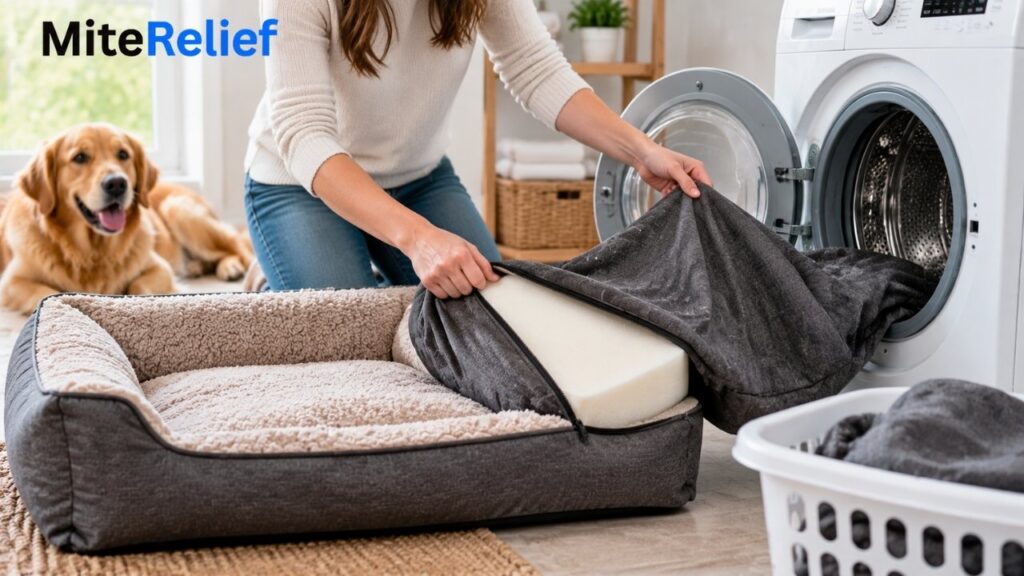
No cleaning routine removes everything, and cleaning cannot treat a pet’s allergy. Match your method to the bed’s design, since the cover, insert, and any sewn-in layers may each call for something different.
Wash Removable Pet Bed Covers Safely
Begin with the care label. It lists the maximum water temperature, the right detergent, and whether you can use a dryer. Warm or hot water can help loosen dust on sturdy fabrics, while delicate ones may shrink or fray. Never go above the label’s maximum.
- Remove the cover and close all zippers and fasteners.
- Ordinary laundry detergent works. Add only the amount the package recommends.
- Wash more often if the cover gets dirty or your pet uses the bed every night.
- Don’t reassemble the bed until the cover is completely dry.
Putting a cover back on while it’s damp keeps that moisture pressed against the foam. That invites odors and mold.
Clean Foam Inserts and Dry Bedding Completely
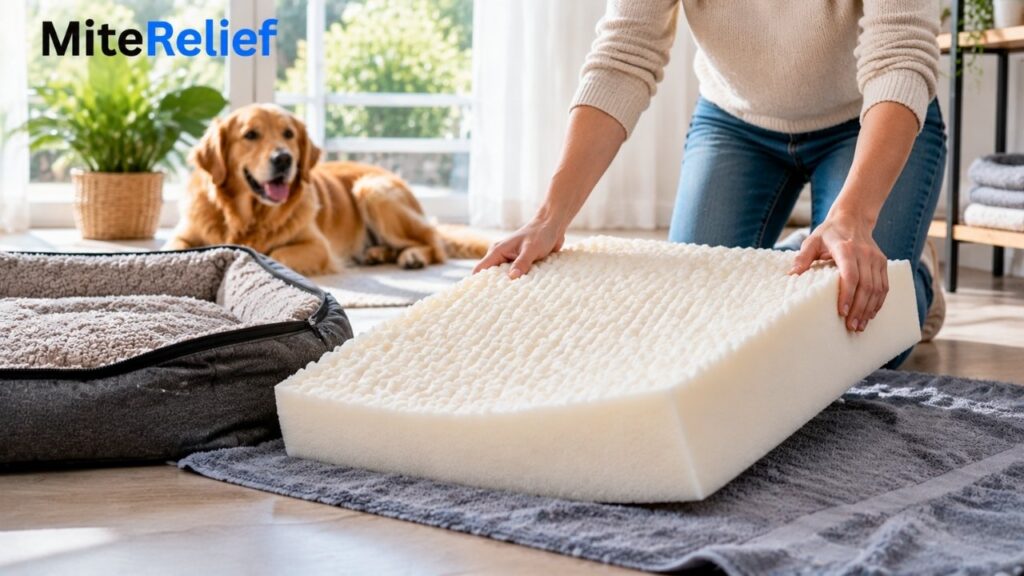
Many foam inserts aren’t meant for the washing machine. Soaking can break down the foam, and the middle may stay wet for days. If the manufacturer does not approve washing, don’t wash the insert.
If the care instructions allow it, dab small stains with a damp cloth and a gentle cleaner, keeping the foam as dry as possible. A vacuum will remove loose hair and surface dust, but it will not reach every mite or allergen particle.
Set the insert somewhere airy and let it dry until it feels dry all the way through. Press the center to check. Use a tumble dryer only when the label says it is safe.
Pesticides, essential oils, and strong chemical sprays are not part of routine care. Solid proof that these products clear away dust mite allergens is lacking.
Which Pet Beds Are Easiest to Keep Clean?
The easiest bed to maintain is one you can fully wash and dry. The table below shows what to look for.
| Bedding feature | Practical implication | Safe recommendation |
| Removable washable cover | Makes regular cleaning simple | Follow the care label |
| Foam insert | Can hold dust and is often hard to wash | Clean only as the maker allows, then dry fully |
| Plush fabric | Tends to trap dust and skin flakes | Vacuum or wash as the label allows |
| Nonwashable sewn bed | Difficult to clean thoroughly | Look for a washable design when buying again |
| Waterproof or protective cover | Repels spills and damp | Don’t count on it to stop dust mite allergens |
Fabric matters too. Cotton and polyester covers are often machine washable, and tightly woven microfiber can be easy to vacuum or wipe. Plush surfaces tend to hold more hair and debris. Memory foam is comfortable, but it usually needs gentle cleaning and a long time to dry.
Treat terms like “hypoallergenic” and ” anti-dust mite with caution, because a tag alone is no proof that a bed keeps allergens out. When shopping for a dust mite dog bed, how easy it is to wash matters more than the wording on the tag.
Machine-washable covers are more dependable than unverified labels. The same logic applies to any dust mite dog bed cover or bed promoted for dust mite allergy: look for washability first.
When Should You Replace a Pet Bed?
Replace a bed when you can no longer clean it well. Signs include:
- Fabric that is torn or worn thin
- Foam that crumbles or has lost its shape
- Odors that stay after you have cleaned and dried the bed
- Dampness that keeps coming back
- A nonwashable bed packed with dirt and hair
In these cases, a new bed may be simpler than scrubbing the old one again and again.
No single schedule fits every bed. A well-kept older bed can be fine, and a neglected newer one can be a problem. A new bed will not erase a pet’s allergy symptoms either.
Frequently Asked Questions (FAQs)
Can dust mites collect inside a foam dog bed?
Dust and skin flakes can build up in and around foam inserts, especially if the foam stays damp. It’s hard to know whether living mites are in a particular insert without testing. Keep the cover washable and the insert dry.
Can a waterproof dog bed cover block allergens?
A waterproof cover can shield the insert from spills and moisture. That doesn’t prove it blocks dust mite allergens. Unless the maker shows test results, treat it as a moisture barrier only.
Is hot washing always safe for dog beds?
No. Some fabrics shrink or break down in hot water. Follow the temperature on the care label.
Do anti-dust-mite dog beds really work?
Claims vary by product, and a label alone doesn’t guarantee protection. An easy-to-wash, easy-to-dry bed is a safer choice.
Can a clean pet bed still contain dust mite allergens?
Yes. Washing reduces dust and debris, but it can’t guarantee complete removal. Regular cleaning helps reduce the amount.
What to Read Next
Conclusion
Pet bedding can hold house dust mite allergens, though not every bed has living mites. Washable covers and easy-care fabrics make routine cleaning simpler. Foam inserts need extra care and must dry completely. Replace a bed when you cannot clean it well.
Cleaning helps, but it does not replace a veterinarian. If your pet keeps itching or symptoms worsen, ask your vet for an assessment.
Medical Disclaimer
This content is for general informational purposes only and is not a substitute for professional medical advice, diagnosis, or treatment. Individual health needs can vary, so speak with a qualified healthcare professional about allergies, asthma, skin reactions, medications, or other symptoms. Seek prompt medical care if symptoms are severe, persistent, or getting worse.

Umar Farooq is the founder of MiteRelief, creating research-backed guides about dust mites, indoor allergens, and practical allergy prevention for healthier homes.