A stuffy nose, itchy eyes, and nonstop sneezing don’t tell you much on their own allergies and a common cold can look almost identical on the surface. What matters is figuring out the cause, since that shapes how you treat it.
Comparing dust mite allergy vs. seasonal allergy gets much simpler once you know which clues to watch for.
Dust mites, pollen, and viruses affect the body differently. They also follow different timelines. One may last for months. Another may only last a few weeks. Once you know what to look for, it gets much easier to tell them apart.
This guide walks through the patterns that set these triggers apart. It won’t replace a doctor’s visit. But it can help you notice clues worth bringing up.
Dust Mite Allergy, Hay Fever, or Cold?
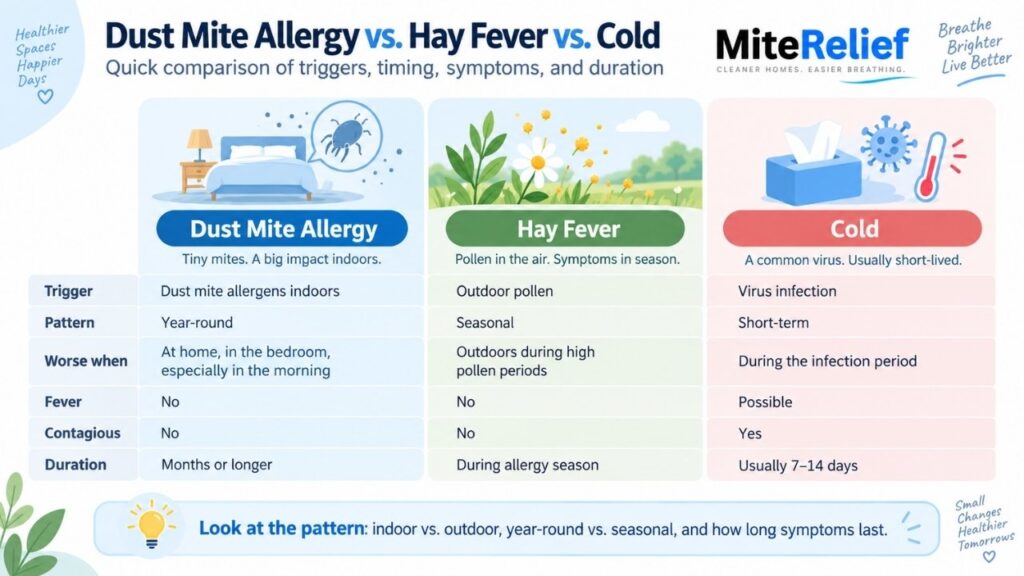
Here’s a fast side-by-side look at how these three conditions usually behave.
| Feature | Dust Mite Allergy | Hay Fever | Cold |
| Trigger | Indoor dust mite allergens | Outdoor pollen | Virus infection |
| Pattern | Year-round | Seasonal | Short-term |
| Worse when | At home, in the bedroom, especially in the morning | Outdoors during high pollen periods | During the infection period |
| Fever | No | No | Possible |
| Contagious | No | No | Yes |
| Duration | Months or longer | During allergy season | Usually 7–14 days |

This table is a starting point. It’s not a diagnosis. Your own pattern of symptoms will tell you more than any single symptom on its own.
Notice how each trigger has its own rhythm. A dust mite allergy tends to stay steady. Hay fever rises and falls with the seasons.
A cold shows up fast and fades within a couple of weeks. Keeping that rhythm in mind can help you sort out what you’re dealing with.
Why Symptom Patterns Matter More Than Symptoms Alone
Sneezing can happen with a dust mite allergy. It can also happen with hay fever or a cold. So can a runny nose and nasal congestion. Symptoms alone won’t tell you much.
Timing and location are much more useful clues. Ask yourself two simple questions. When do your symptoms show up? Where do they get worse?
Duration matters too. A cold usually fades within two weeks. Allergic rhinitis works differently. It can stick around for months if the trigger is still nearby. That long stretch is one of the clearest signs that a cold isn’t the cause.
Think about your last flare-up. Did it start suddenly and fade on its own? Or has it been dragging on for weeks without much change? That single question often narrows things down fast.
Dust Mite Allergy vs Hay Fever: Indoor vs Outdoor Triggers

Dust mites are indoor allergens. They live in soft, warm places like mattresses, bedding, carpets, and upholstery. You won’t find them blowing around outside.
They also thrive in higher humidity, which is why indoor moisture levels can affect how severe your symptoms feel.
Hay fever works the opposite way. It’s linked to outdoor pollen from trees, grasses, and weeds. Your symptoms tend to rise and fall with the pollen counts in your area. On a high-pollen day, you may notice symptoms the moment you step outside.
This location difference is one of your best clues. Symptoms that stay steady year-round often point to an indoor trigger.
Symptoms that come and go with the seasons usually point toward pollen. Even the room you’re in can matter. A living room with a lot of soft furniture may feel different from a room with hard floors and less upholstery.
Indoor Patterns That Suggest Dust Mite Exposure
A few patterns tend to show up again and again with dust mite exposure:
- Symptoms are worse right after waking up
- Symptoms flare up more at home than anywhere else
- Symptoms ease up when you spend time away from home
- Symptoms return once you’re back in your usual space
If this sounds familiar, it may be worth learning more about dust mites in your bedroom, since exposure is often highest there.
Dust Mite Allergy vs Cold: How the Patterns Differ
A cold and a dust mite allergy can feel surprisingly similar at first. Both can bring on sneezing, a runny nose, and general tiredness. But a few differences usually stand out once you pay attention.
| Difference | Dust Mite Allergy | Cold |
| Fever | Usually no | Possible |
| Duration | Can continue for weeks, months, or longer | Usually improves within days to 1–2 weeks |
| Body aches | Less common | Common |
| Contagious | No | Yes |
| Main trigger | Dust mite allergens | Virus infection |
| Pattern | Often returns with exposure | Usually follows a short illness pattern |
| Location | Often worse indoors, especially at home | Can happen anywhere |
Fever and Body Aches Are Major Clues
A fever is one of the clearest signs that something other than allergies is going on. Allergic rhinitis usually doesn’t cause a fever. If you’re running a temperature, a cold or another infection is more likely.
Body aches follow a similar pattern. They’re common with colds but far less common with dust mite allergy. If your whole body feels sore, not just your nose and eyes, a cold is the more likely explanation.
Duration Helps Separate Allergies From Infection
Colds tend to run their course in a week or two. Your body fights off the virus, and the symptoms fade on their own.
If your symptoms are still hanging around after that, an allergy becomes a more likely explanation. This is especially true if you keep noticing the same common dust mite allergy signs week after week, with no real improvement.
How Can I Tell If I Have a Dust Mite Allergy?
Try what’s sometimes called the location test a quick way to spot a pattern by paying attention over a few days:
- Symptoms feel stronger in your bedroom than anywhere else
- Mornings bring on more sneezing than afternoons or evenings
- Getting away from home for a while brings some relief
- Coming back home brings the symptoms right back
This kind of pattern can suggest a dust mite allergy, but it doesn’t confirm it on its own. Plenty of things in a home can cause similar symptoms. Testing for dust mite allergies is the only way to know for sure what’s triggering your symptoms.
It also helps to think about which rooms bother you most. If your bedroom feels worse than the rest of the house, that’s a strong clue. Bedrooms tend to have the most bedding and the most time spent close to a mattress, which is exactly where dust mites like to gather.
Can You Have Both Dust Mite Allergy and Hay Fever?
Yes, and this is more common than you might think. Many people react to more than one allergen at the same time.
If that’s the case for you, your symptoms might stick around all year at a low level. Then they get worse during pollen season. That mix of a steady, year-round pattern with seasonal spikes often means more than one trigger is involved.
This mix can be tricky to sort out on your own. A steady baseline from dust mites, combined with a seasonal spike from hay fever, can make it feel like your allergies never fully go away. That pattern itself is a useful clue when you talk to a doctor.
When Should You Get Allergy Testing?
It’s not always necessary to test right away, but a few signs suggest it may be worth the visit:
- Your symptoms have lasted for months without improving
- Your sleep is being disrupted regularly
- Your symptoms are getting in the way of work or school
- You’re still unsure what’s actually triggering your symptoms
Allergy testing can help confirm whether dust mites, pollen, or something else is behind how you feel. It takes the guesswork out. Instead of watching for patterns on your own, you get a clear answer about what’s triggering your symptoms.

For more background on your symptoms before you go, review dust mite allergy signs and dust mite allergy test. Knowing what to expect can visit feel less overwhelming.
Frequently Asked Questions
How do I know if I have dust mites or hay fever?
Pay attention to when and where your symptoms show up. A dust mite allergy tends to stick around all year and feels stronger at home, while hay fever comes and goes with the pollen calendar and eases once that plant’s season passes.
Can dust mite allergy cause a fever?
Not on its own. A fever usually points to something like a cold or the flu rather than an allergy, so a high temperature is a sign to look beyond dust mites as the cause.
Why are my allergy symptoms worse indoors?
Your home holds onto certain allergens. Dust mites settle into bedding, carpets, and upholstered furniture and stay there, while hay fever comes from pollen carried in from outside.
Can I have dust mite allergy and seasonal allergies together?
It’s possible. Many people are sensitive to more than one allergen at once, which can leave them with year-round background symptoms plus extra flare-ups when pollen season hits.
If my symptoms improve on holiday, does that mean I have a dust mite allergy?
It’s a hint, not proof. Feeling better away from home points to something in your house, but only testing can confirm that dust mites are the cause.
What to Read Next
Conclusion
Dust mite allergy, hay fever, and colds can all look the same at first glance. But once you look past the symptoms themselves, the differences become much clearer. Trigger, timing, and duration set them apart.
Dust mites tend to cause a steady, year-round pattern tied to your home. Hay fever rises and falls with the pollen season. A cold usually clears up within a couple of weeks and can come with a fever.
Paying attention to your own pattern is the first step. Notice when your symptoms flare up, where they get worse, and how long they tend to last. From there, allergy testing for dust mites can give you a clear answer instead of a guess.
You can also learn more about what are dust mites and how to prevent dust mites once you have a better sense of what’s behind your symptoms.
Medical Disclaimer
This content is for general informational purposes only and is not a substitute for professional medical advice, diagnosis, or treatment. Individual health needs can vary, so speak with a qualified healthcare professional about allergies, asthma, skin reactions, medications, or other symptoms. Seek prompt medical care if symptoms are severe, persistent, or getting worse.

Umar Farooq is the founder of MiteRelief, a resource for dust mite control and allergy prevention. After battling allergen sensitivity, he started creating research-backed guides that turn complex indoor air quality science into practical, affordable solutions anyone can implement.