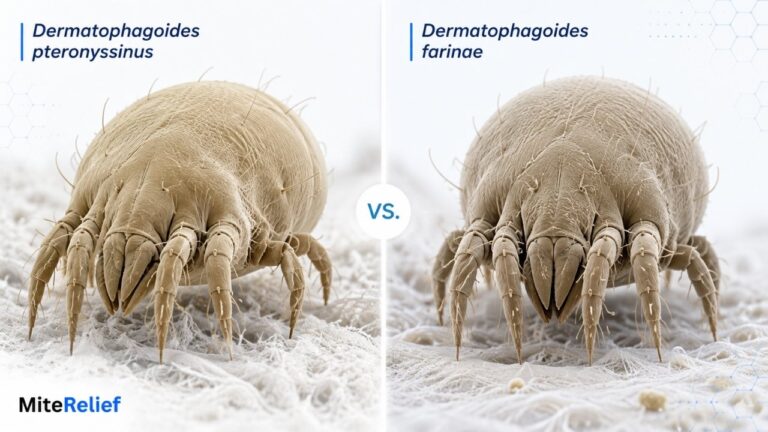
If your allergy test shows Dermatophagoides pteronyssinus or D. farinae, you might wonder what those names mean. These two house dust mite species are among the most common causes of indoor allergies.
Together, they’re often listed as house dust mite pteronyssinus and farinae on a lab report. Knowing the difference can help you understand your results.
What Are Dermatophagoides Pteronyssinus and D. Farinae?
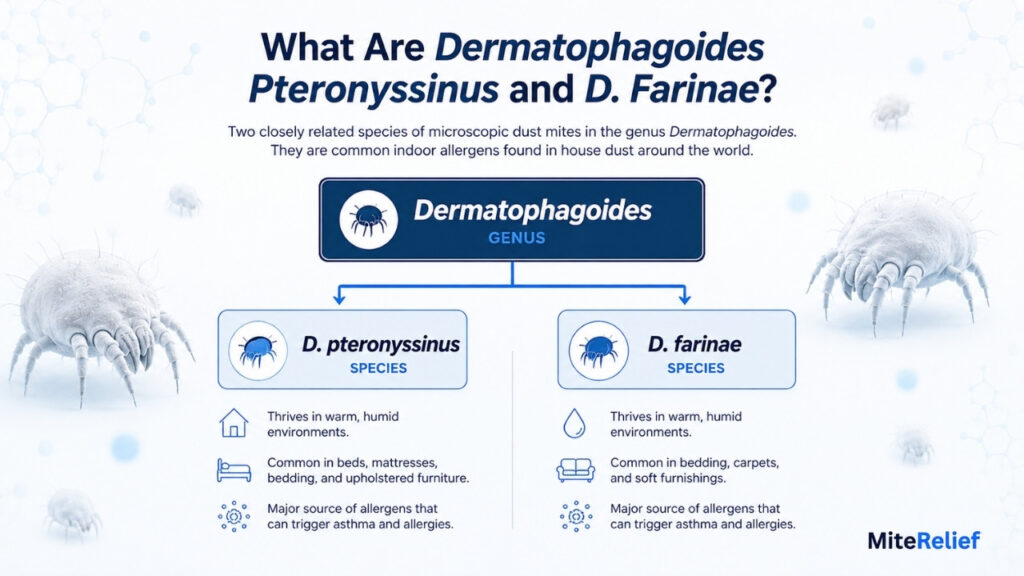
Dermatophagoides is the scientific genus that these two dust mite species belong to. Both are tiny bugs that live in homes and feed on skin flakes.
But not all house dust mites are the same, and that’s why allergy labs test for specific species.
Testing for each species separately helps doctors understand what’s really triggering your symptoms.
A general dust mite label wouldn’t tell you which mite is the bigger problem in your home. That’s where species identification comes in.
This article focuses on the science behind these two species and what their allergy codes mean. For a broader look at dust mites in general, check out our guide on What Are Dust Mites.
Labs separate these species because their allergens aren’t exactly the same. A person’s immune system can respond more strongly to one species than the other.
That’s why your allergy report may list results for each one on its own, rather than lumping all dust mites together.
Dermatophagoides Pteronyssinus: The Common Humidity-Loving Species
Dermatophagoides pteronyssinus is one of the most studied house dust mite species in the world. It thrives in humid conditions, which is why it’s especially common in Europe, parts of Asia, and other humid climates.
On an allergy test, this species shows up under the code d1. If your report lists a d1 result, it means you were tested for dust mite sensitization to D. pteronyssinus specifically.
The main allergens linked with this species are proteins called Der p1, Der p2, and Der p23. These proteins come from the mite’s body and waste, and they’re what your IgE antibodies react to.
A positive d1 result suggests your body may be sensitized to these proteins, though it doesn’t guarantee that this species is causing your symptoms.
Humidity plays a big role in where D. pteronyssinus thrives. It needs moisture in the air to survive, so it tends to struggle in very dry indoor spaces.
This is part of why researchers often connect this species with coastal or humid regions rather than dry ones.
Dermatophagoides Farinae: How It Differs From D. Pteronyssinus
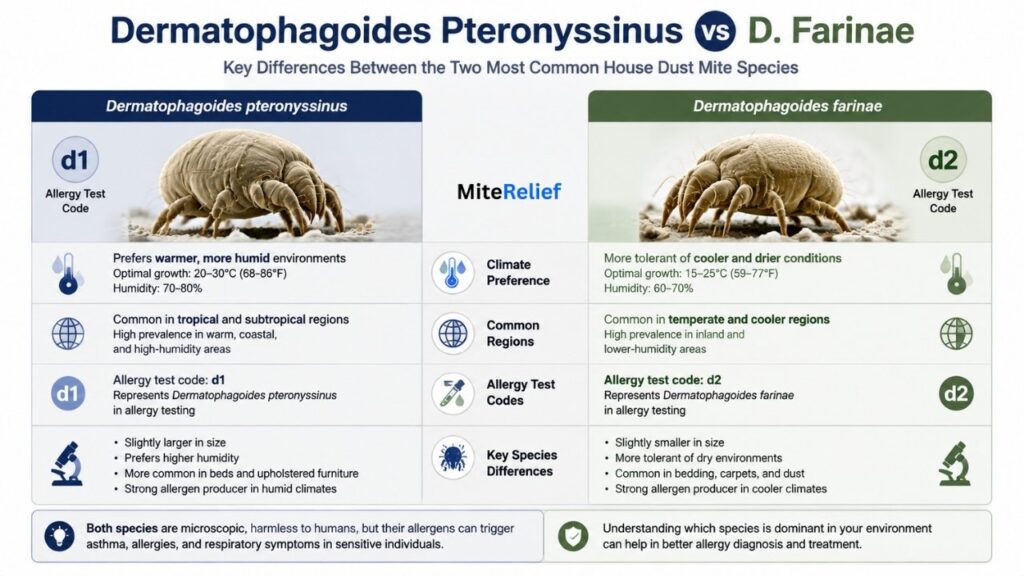
Dermatophagoides farinae is sometimes called the American house dust mite. It’s especially common in North America and tends to do well in drier climates than D. pteronyssinus prefers.
On an allergy test, this species is listed under the code d2. A d2 result means you were tested specifically for sensitization to D. farinae.
The main allergens tied to this species are Der f1 and Der f2. Like their D. pteronyssinus counterparts, these proteins trigger an immune response in sensitized people.
Both species share a lot in common. They’re close relatives, similar in size, and both live off shed skin cells in household dust. Still, labs classify them separately because their allergens, though related, aren’t identical, and people can react differently to each one.
Temperature and moisture levels help explain why D. farinae can handle drier air better than D. pteronyssinus. This doesn’t mean D. farinae can’t be found in humid areas too.
It just tolerates a wider range of indoor conditions, which helps explain why it’s so common across the United States.
Der p1, Der p2, Der f1, and Der f2: Understanding Dust Mite Allergens
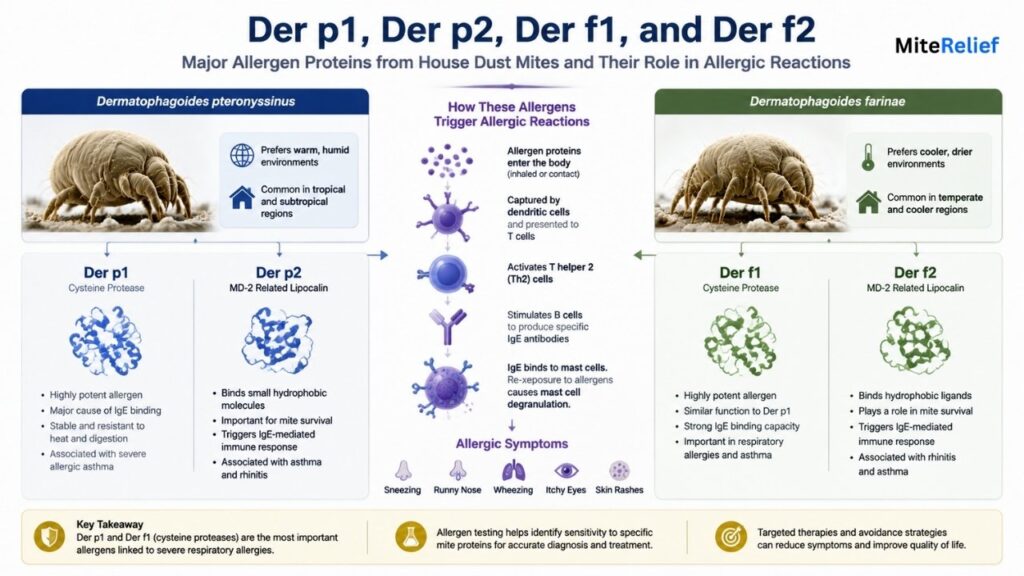
Allergen proteins are the specific substances that cause an allergic reaction. In the case of dust mites, these proteins come from their bodies, feces, and shed skin.
Der p1 and Der p2 proteins come from Dermatophagoides pteronyssinus. Der f1 and Der f2 proteins come from Dermatophagoides farinae. The “p” and “f” simply stand for each species’ name.
Der p1 and Der f1 are both cysteine proteases, a type of enzyme that can break down proteins in the skin barrier.
This is part of why they’re linked with skin reactions like eczema from dust mites in sensitized individuals. Der p2 and Der f2 work differently, but both can also trigger an immune response.
Because Der p and Der f proteins are structurally similar, some cross-reactivity can happen. This means a person sensitized to one species’ allergens may also react, to some degree, to the other species’ allergens, even without direct exposure.
Dust mite sensitization is a type of type 1 hypersensitivity, which is the same immune pathway involved in many common allergies.
In sensitized individuals, this reaction can be linked with allergic rhinitis or asthma, alongside skin issues like atopic dermatitis. Not everyone who is sensitized will develop noticeable symptoms, though.
What Do D1 and D2 Mean on a Dust Mite Allergy Test?
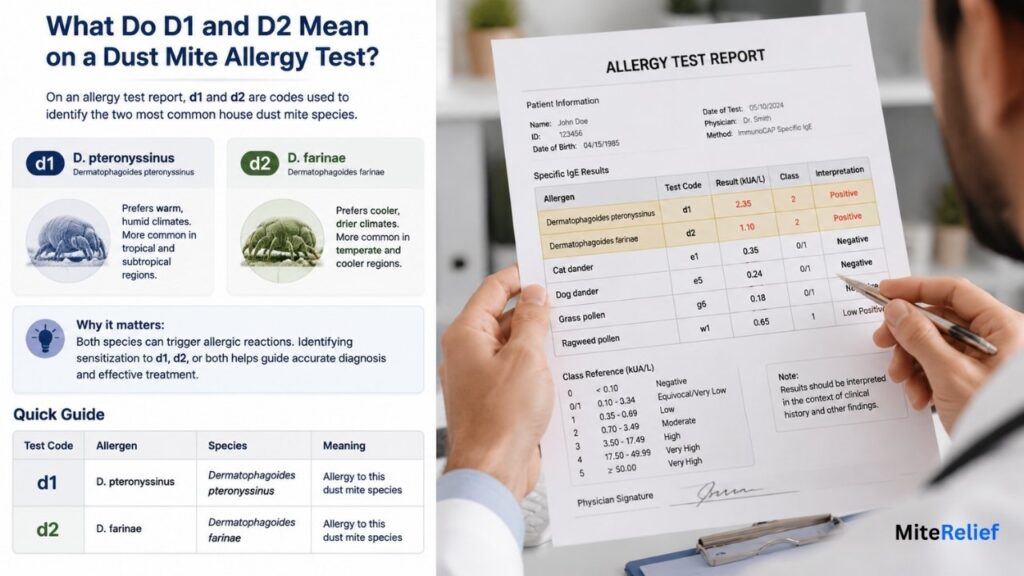
If you’re looking at your allergy report, d1 stands for Dermatophagoides pteronyssinus, and d2 stands for Dermatophagoides farinae.
These codes are shorthand that allergists and labs use to keep species results organized.
A positive result on either code shows sensitization, meaning your immune system has produced IgE antibodies against that species’ allergens. IgE, short for Immunoglobulin E, is the antibody your body makes when it flags something as a threat, even when it’s harmless.
It doesn’t automatically mean that species is causing your day-to-day symptoms. Results are most useful when read alongside your symptoms and medical history.
Allergy testing for dust mites is usually done through a blood test or skin prick testing. A blood test measures specific IgE levels in a sample of your blood, while a prick test checks your skin’s reaction to a small amount of allergen.
Either method can report results by species, which is where the d1 and d2 codes come from.
Species identification helps your allergist because it points to which allergens your body is reacting to. If you’d like to learn more about how this testing works, our guide to Dust Mite Allergy Test covers the basics.
Why Does Knowing the Dust Mite Species Matter?
Knowing which species you’re sensitized to can help explain why your allergies feel a certain way. Some people react more strongly to D. pteronyssinus, while others react more to D. farinae, and some react to both.
This matters because sensitivity isn’t the same for everyone. Two people with dust mite allergies can have very different results depending on which allergens their immune system targets.
Both species can be relevant during an allergy evaluation, especially if you live somewhere both are common. Knowing the specific species involved gives you and your allergist more useful information than a general dust mite label alone.
This level of detail can also help you understand why your symptoms might change with the seasons or after moving to a new climate.
If humidity levels shift where you live, the balance between D. pteronyssinus and D. farinae in your home could shift too, and your symptoms might follow.
Can D. Pteronyssinus and D. Farinae Live in the Same Home?
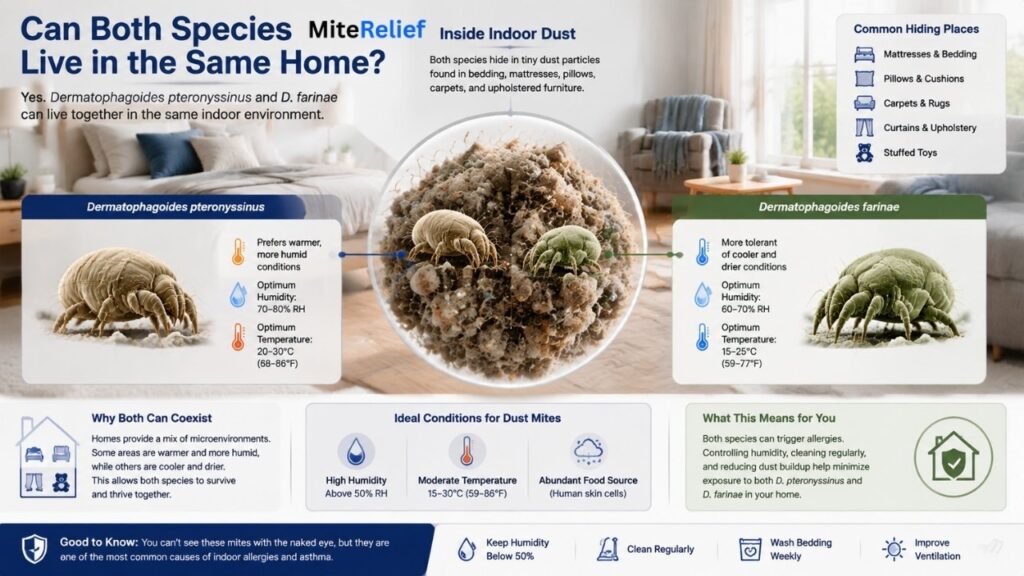
Yes, both species can live in the same home at the same time. While climate affects which species is more common in a given region, homes often aren’t limited to just one.
Someone living in a humid area might have more D. pteronyssinus, while someone in a drier climate might see more D. farinae.
Indoor humidity, temperature, heating, and cooling can all shift the balance between the two.
Because both species can be present indoors, a person may be exposed to allergens from each one.
Bedding and mattresses tend to hold the highest concentration of dust mite allergens in a home, since that’s where skin flakes collect most. For tips on managing dust mites in your home, take a look at our guide on How to Prevent Dust Mites.
Frequently Asked Questions
What does Dermatophagoides pteronyssinus mean?
Dermatophagoides pteronyssinus is the scientific name for one of the two main house dust mite species linked with allergies. Researchers have studied it closely because it’s one of the most common indoor allergy triggers worldwide.
Is D. pteronyssinus or D. farinae more common?
It depends on where you live. D. pteronyssinus tends to be more common in humid regions, while D. farinae is more common in drier climates, including much of North America.
Are Der p1 and Der f1 the same allergen?
They’re similar but not identical. Both are cysteine proteases from their respective species, and their similarity can lead to some cross-reactivity between the two.
What is the difference between d1 and d2 on allergy tests?
D1 refers to Dermatophagoides pteronyssinus, and d2 refers to Dermatophagoides farinae. These codes tell you which species your test measured sensitization to.
If I test positive for one species, does it mean I react to both?
Not always. Some people do show cross-reactivity between the two species, but individual sensitivity varies, so a positive result for one doesn’t guarantee a reaction to the other.
What To Read Next
- What Are Dust Mites?
- Dust Mite Allergy Test.
- Dust Mite Allergies & Symptoms.
- How to Prevent Dust Mites.
Conclusion
Dermatophagoides pteronyssinus and D. farinae are the two main house dust mite species linked with allergy testing.
On an allergy report, they usually show up as d1 and d2. While the two species share a lot in common, their allergen proteins and preferred climates can differ.
Understanding these differences can make your allergy report easier to read.
It also gives you a better starting point for talking with your allergist about your specific sensitivities. Knowing which dust mite species shows up on your report can turn a confusing set of scientific terms into something you actually understand.
Medical Disclaimer
This content is for general informational purposes only and is not a substitute for professional medical advice, diagnosis, or treatment. Individual health needs can vary, so speak with a qualified healthcare professional about allergies, asthma, skin reactions, medications, or other symptoms. Seek prompt medical care if symptoms are severe, persistent, or getting worse.

Umar Farooq is the founder of MiteRelief, a resource for dust mite control and allergy prevention. After battling allergen sensitivity, he started creating research-backed guides that turn complex indoor air quality science into practical, affordable solutions anyone can implement.