If you keep breaking out in itchy, raised bumps and you already know you’re sensitive to dust mites, it’s fair to wonder if they’re connected. Dust mite allergy hives are a real possibility for some people, but they’re not the only explanation.
Hives, also called urticaria, are raised, itchy welts that can appear quickly and fade just as fast. If you have a known or suspected dust mite allergy, it’s natural to ask whether your bedroom is triggering them.
Here’s the short answer: dust mites may play a role in hives for some people sensitised to them, but hives can have many different causes.
You can’t look at a welt and know for sure that a dust mite caused it. Timing and exposure patterns can offer clues, but they don’t prove anything on their own.
This article is for general information. If your hives keep coming back or you’re not sure what’s causing them, talk to a doctor.
Can Dust Mite Allergy Cause Hives?
Yes, dust mites may be linked to hives in people who are sensitised to them, but they’re not the only cause, and not everyone with a dust mite allergy gets hives.
Here’s roughly how it works. House dust mites shed tiny protein particles. A sensitised immune system treats these proteins as a threat.
The immune system makes IgE antibodies that target dust mite proteins. On the next exposure, those antibodies can trigger mast cells in the skin.
Mast cells then release histamine and other chemicals. Histamine causes much of the itching, swelling, and welts.
Having a dust mite allergy doesn’t mean every hive comes from mites, though. Many other allergic and non-allergic triggers can cause the same kind of reaction.
What Do Dust Mite Allergy Hives Look Like?
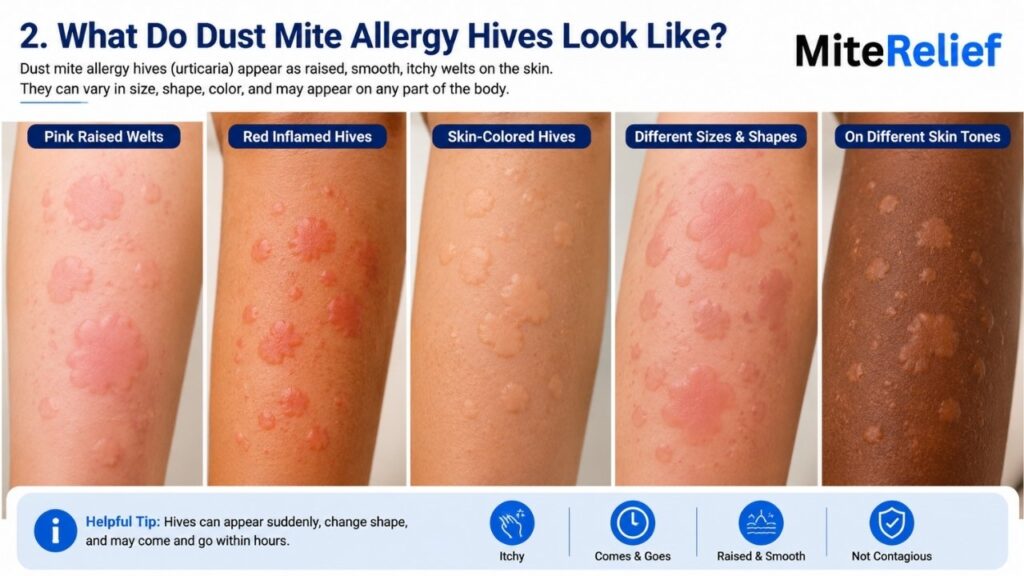
No special look marks a hive as caused by dust mites. Hives from dust mite exposure look like hives from any other cause.
Typical urticaria shows up as raised wheals or welts. They can be red, pink, or close to your normal skin tone. The surface usually feels smooth, and the itching can be intense.
Shapes vary widely: round, oval, or irregular. Some wheals stay small; others merge into bigger raised patches.
They can change size or shape within minutes, and it’s common for a fresh batch of welts to show up while older ones fade.
Most individual wheals fade within about 24 hours. New ones can pop up somewhere else, which can make it seem like the hives are travelling.
If a bump stays in the same spot for much longer than that, it’s worth getting it checked out rather than assuming it’s a stubborn hive.
The bottom line: the appearance can tell you it’s urticaria. It can’t tell you what caused it.
Dust Mite Hives vs Rash or Eczema
Knowing the difference between hives and other skin problems helps, since they’re treated differently.
| Feature | Hives / Urticaria | Rash / Eczema |
| Appearance | Raised wheals | Dry, irritated, or inflamed patches |
| Onset | Often sudden | Usually more gradual |
| Movement | Can shift to new spots | Usually stays in one area |
| Surface | Usually smooth | May be dry, cracked, or scaly |
| Duration | Individual wheals often fade within 24 hours | Can last for days or longer |
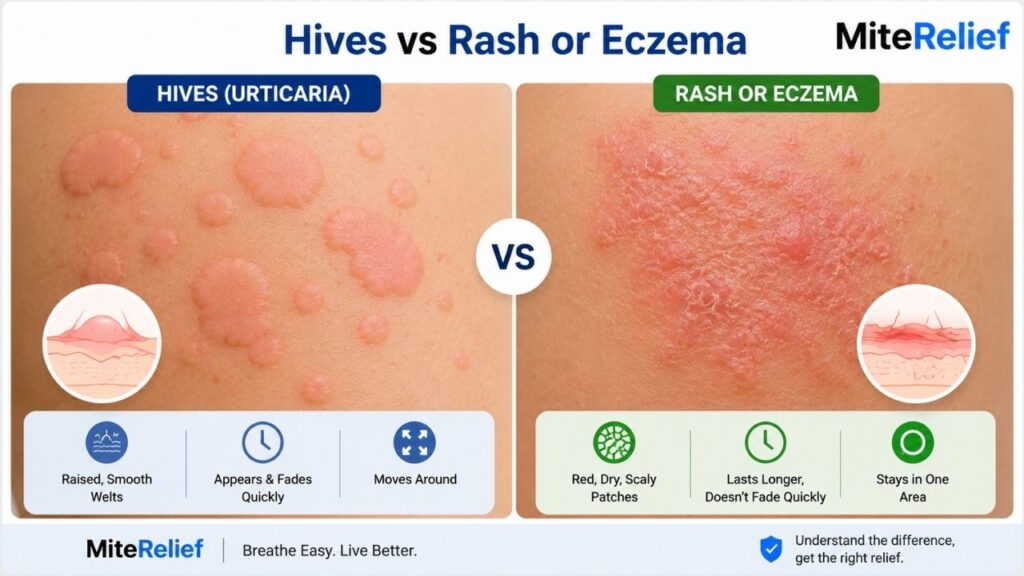
Eczema and ongoing rashes differ from hives and may need different care. If your symptoms sound more like dry, scaly, long-lasting patches than sudden raised welts, our guide to dust mite rash and skin symptoms covers that in more depth.
Why Do Hives Appear, Disappear or Move Around?
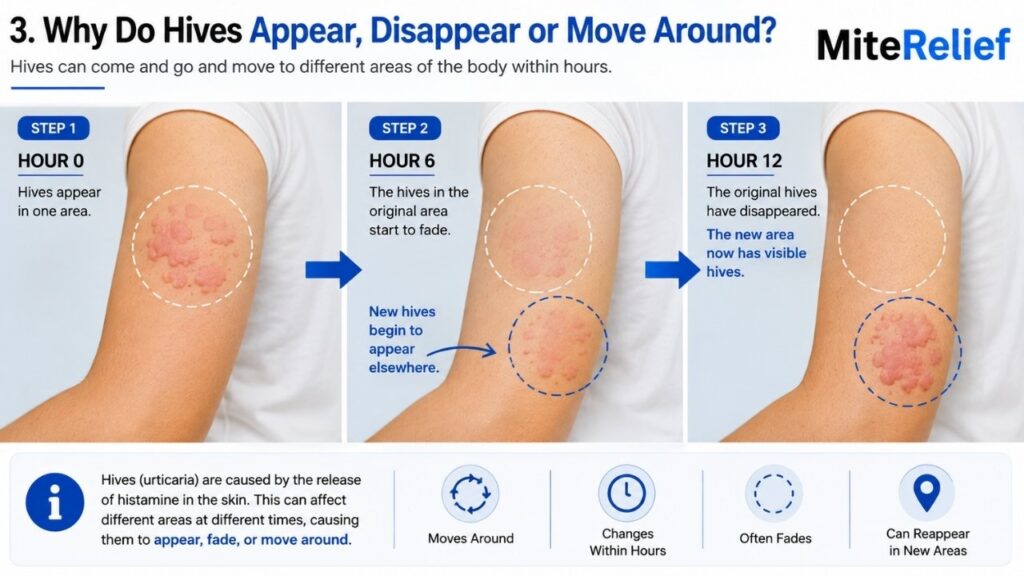
Hives often seem to move. Here’s what’s actually happening.
Each individual wheal has its own short lifespan: it swells, then fades, often within a day. While that’s happening, new wheals can form somewhere else on your body.
Sizes and shapes shift quickly, and small welts sometimes merge into larger raised areas.
This shifting pattern is normal in urticaria. It’s different from many rashes, which tend to stay put in one area for a longer stretch.
When you’re tracking your symptoms, pay attention to how long each welt lasts, not just how many days the whole episode lasts. That detail can be genuinely useful if you discuss it with a doctor.
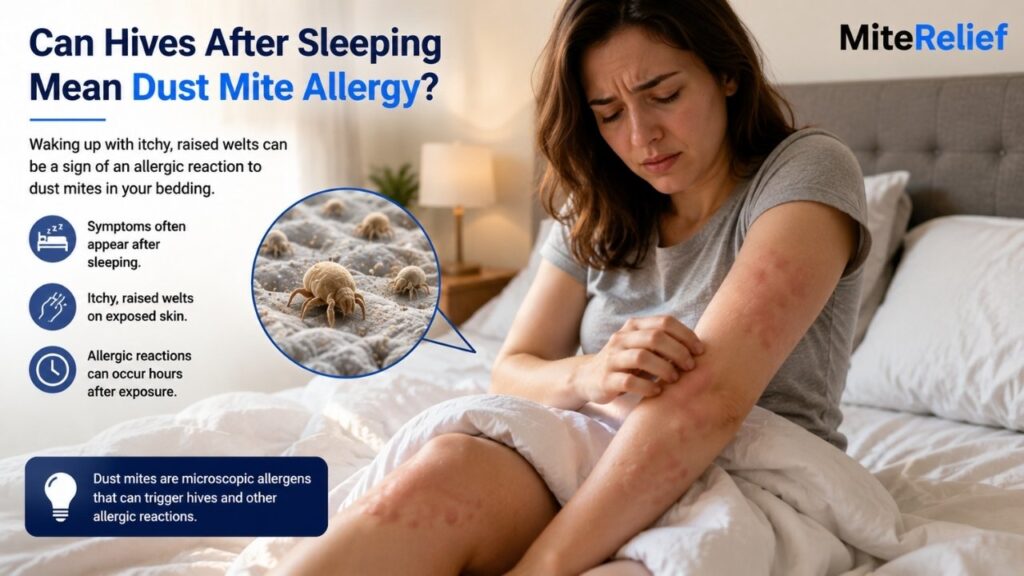
Can Hives After Sleeping Mean Dust Mite Allergy?
Dust mite allergens tend to build up around mattresses, pillows, and bedding the places where you spend hours breathing and lying still. If you’re already sensitised, it makes sense to notice symptoms after a night in bed.
But waking up with hives doesn’t automatically prove dust mites are the cause. A few other things can play a role too:
- Heat
- Sweating
- Pressure from lying on the skin
- Medications
- An infection
- Certain foods
- Other allergens in your environment
If you notice the same pattern night after night hives that consistently show up after sleep that’s a useful detail to bring to a healthcare professional. Timing alone isn’t a diagnosis, but it can point an investigation in the right direction.
How Do Doctors Investigate Recurring Hives?
If hives keep coming back, a doctor will usually start by asking questions rather than jumping straight to testing. Expect questions like:
- When did the hives start?
- How often do they happen?
- How long does each welt last?
- Do they follow any particular exposure?
- Have you had a recent infection?
- Any new medicines or supplements?
- Any specific foods, heat, cold, or pressure involved?
- Do you have a known allergy history?
It can help to keep photos of active hives, along with notes on timing and possible exposures. That record often says more than memory alone.
Skin-prick testing or specific IgE blood testing may come up if your history points toward a relevant allergy.
But it’s worth knowing: a positive dust mite result shows Sensitization; it doesn’t prove dust mites caused that particular batch of hives. For a deeper look at how testing works, see our guide to dust mite allergy testing.
Acute vs Chronic Urticaria
Doctors sort urticaria into two broad categories based on how long it sticks around.
Acute urticaria means hives that last, or keep recurring, for less than six weeks. Triggers can include allergic reactions, infections, medicines, foods, environmental exposures, or physical triggers like pressure or cold.
Dust mites are just one item on that longer list, not the default explanation.
Chronic urticaria means hives that keep recurring for more than six weeks. This is different from a single allergic flare-up. The cause is often less obvious.
Ongoing hives don’t automatically mean someone is still being exposed to dust mites. When symptoms stretch on this long, a proper medical assessment matters more.
Chronic Urticaria: When Dust Mites May Not Be the Cause
This distinction matters, so it’s worth spelling out clearly: many cases of chronic urticaria don’t have one obvious outside allergen behind them.
Some are classified as chronic spontaneous urticaria, meaning hives keep appearing without a clear external trigger.
If you have dust mite sensitization and also have long-running hives, it’s tempting to connect the two. But a positive allergy result needs to be weighed alongside your history and symptoms; it isn’t proof by itself.
Other factors can also contribute to chronic cases, including autoimmune processes, infections, medications, or physical urticarias triggered by pressure, heat, or cold.
If hives persist or keep returning, see an allergist, dermatologist, or other qualified healthcare provider.
How Are Hives Treated?
Treatment for urticaria usually starts with antihistamines. Second-generation antihistamines are commonly used because they tend to cause less drowsiness than older options.
Examples include cetirizine, loratadine, and fexofenadine; they work by blunting the effects of histamine in the skin.
None of these is automatically the best choice for every person. A doctor or pharmacist can help match a medicine to your situation.
A cold compress can offer some temporary relief from itching. Scratching tends to make things worse. If a specific trigger is confirmed or strongly suspected, avoiding it may help too.
If hives keep coming back or won’t settle down, see a healthcare provider. For more detail on allergy medicine options, see our guide to dust mite allergy medicines.
Can Reducing Dust Mite Exposure Help?
If dust mites are a confirmed or strongly suspected trigger for you, cutting back on exposure may help.
That can include washing bedding regularly, keeping humidity in check, reducing dust buildup, and using allergen barriers where they make sense.
We won’t get into the details here; our full guide on how to prevent dust mites covers that.
Just keep in mind: cleaning up your environment shouldn’t replace a proper medical look at hives that don’t have a clear explanation.
Angioedema and Hives: What Is the Difference?
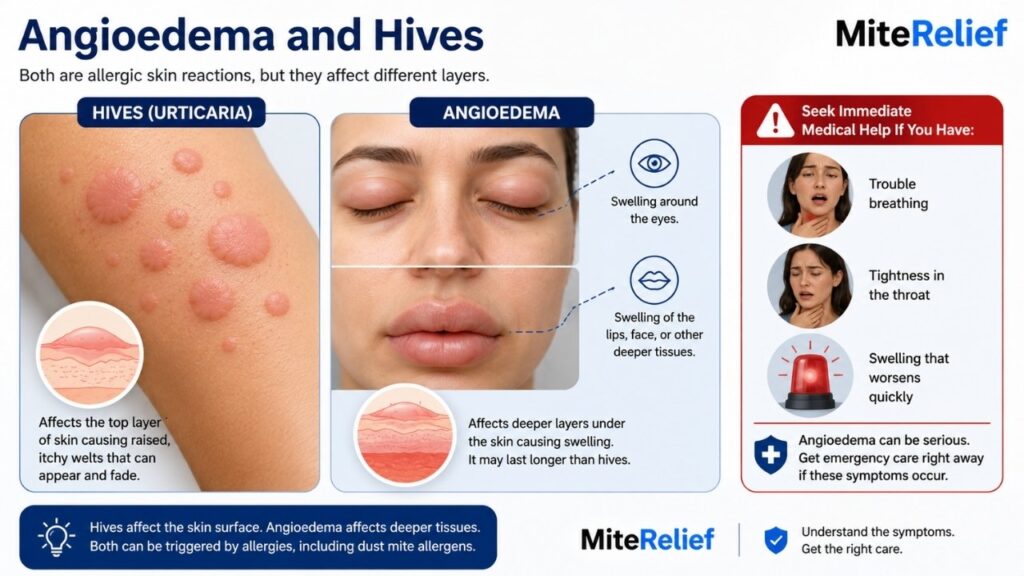
Angioedema is deeper swelling that can show up alongside hives. While hives affect the upper layers of skin, angioedema reaches deeper tissue, often around the lips, eyelids, or other soft areas.
The two can happen together or separately. Angioedema isn’t a full topic on its own here, but it’s worth knowing the difference, especially since deeper swelling can sometimes be a warning sign worth watching closely.
When Are Hives a Medical Emergency?
Most of the time, hives alone aren’t an emergency. But hives combined with signs of a serious body-wide reaction need urgent care.
Get emergency medical help right away if hives come with any of these:
- Difficulty breathing
- Throat tightening
- Tongue swelling
- Significant lip swelling
- Wheezing
- Trouble swallowing
- Fainting
- Severe dizziness
- Symptoms that are rapidly getting worse
Don’t wait these out. This kind of reaction can escalate quickly and needs prompt medical attention.
It’s worth being clear that dust mite allergy isn’t a common cause of anaphylaxis. This warning applies to hives and allergic reactions in general, not to dust mites specifically.
Frequently Asked Questions (FAQs)
Can dust mites cause hives all over the body?
Urticaria can spread across many areas of the body, but where it shows up doesn’t tell you what caused it.
How long do dust mite allergy hives last?
Individual welts usually fade within about 24 hours, though new ones can keep appearing during a flare-up.
Can hives move from one place to another?
Yes. Older welts fade out while new ones form somewhere else, which can make hives look like they’re travelling.
Do bites cause dust mite hives?
No. Dust mites don’t bite people. Learn more in our guide on whether dust mites bite.
Can you have dust mite allergy without hives?
Yes. Many people with dust mite sensitization never develop hives.
Should recurring hives be allergy tested?
It depends on your history and suspected triggers. A healthcare provider is best placed to decide if testing makes sense for you.
What to Read Next
- Dust Mite Rash & Skin Symptoms
- Dust Mite Allergy Testing
- Dust Mite Allergy Medicines
- How to Prevent Dust Mites
Conclusion
Dust mites may play a role in hives for some sensitised people, but hives can have many possible causes. Typical urticaria shows up as itchy, raised wheals that change shape, fade, and reappear somewhere new.
Hives after a night’s sleep might hint at exposure, but that timing alone doesn’t prove dust mites are behind it.
If hives stick around for more than six weeks, that points toward chronic urticaria, which deserves its own medical look.
Testing can confirm sensitization, but it can’t settle what caused a specific flare-up on its own.
And if hives ever show up with breathing trouble, throat swelling, fainting, or symptoms that are getting worse fast, that’s a signal to get emergency care right away.
Medical Disclaimer
This content is for general informational purposes only and is not a substitute for professional medical advice, diagnosis, or treatment. Individual health needs can vary, so speak with a qualified healthcare professional about allergies, asthma, skin reactions, medications, or other symptoms. Seek prompt medical care if symptoms are severe, persistent, or getting worse.

Umar Farooq is the founder of MiteRelief, a resource for dust mite control and allergy prevention. After battling allergen sensitivity, he started creating research-backed guides that turn complex indoor air quality science into practical, affordable solutions anyone can implement.