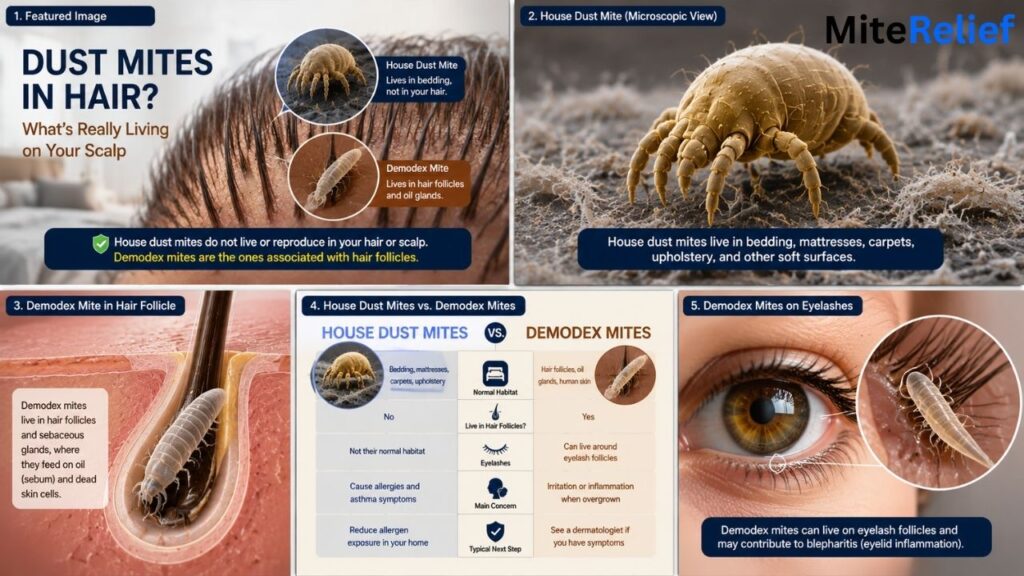
Is your scalp itchy? Are you worried that something is living in your hair? If so, house dust mites are probably not the cause.
Dust mites in hair are a common worry, and it’s easy to see why. Itching is uncomfortable, and it’s natural to want an answer fast.
But these mites don’t actually live on your scalp.
There’s a different mite, called Demodex, that can live around your hair follicles. That’s where a lot of the confusion starts.
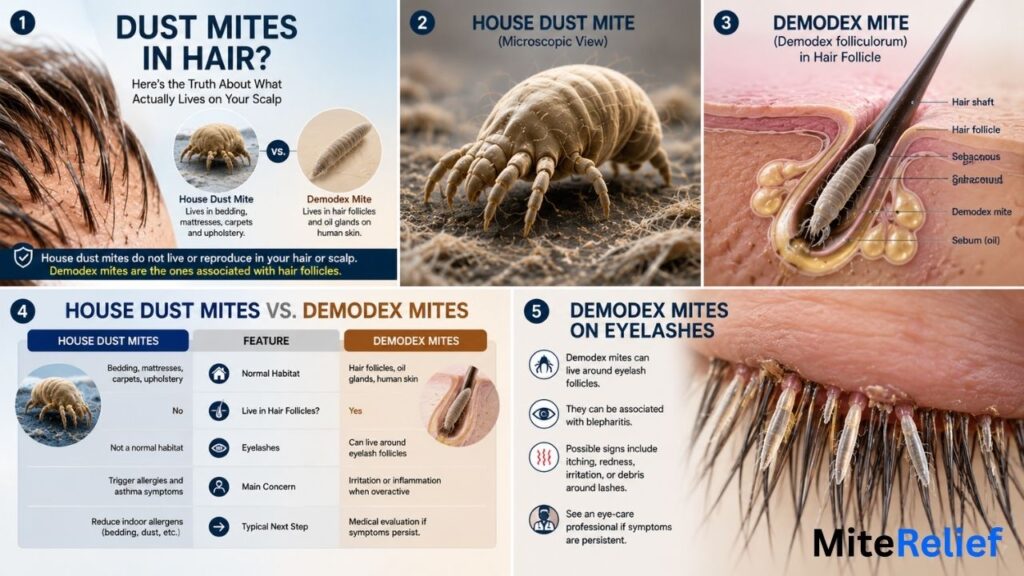
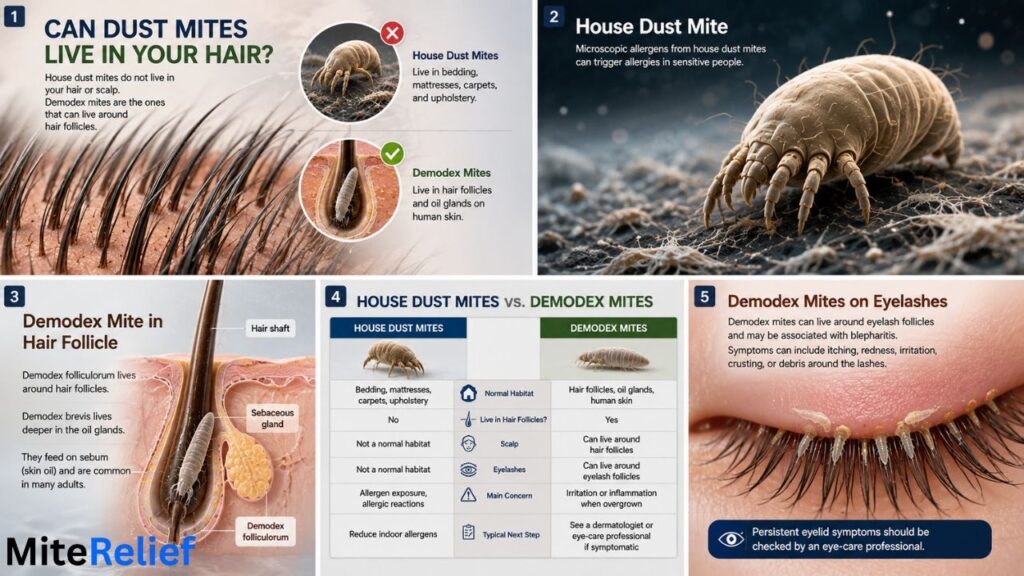
Quick Answer: House dust mites do not normally live in human hair. They don’t breed there, either. Your scalp is not their normal home.
They are more commonly found in bedding, carpets, and upholstered furniture. Demodex mites are a different story.
This separate type of mite can live around human hair follicles. That includes follicles on the scalp and around the eyelashes.
Can Dust Mites Live in Your Hair?
Can dust mites live in your hair? Not really. House dust mites feed on tiny flakes of shed skin.
They thrive in bedding, mattresses, carpets, and upholstery. Your scalp doesn’t offer what they need to survive.
Can dust mites get in your hair at all? Sometimes, yes. A stray mite might land on your hair for a short time.
So might bits of dust mite allergens. This can happen after you’ve been in bed for a while. But landing on your hair is not the same as living there.
Getting onto your hair isn’t the same as living in it.
This is a small but important difference. Dust mites need damp, sheltered spots. They also need a steady food supply, mostly shed human skin cells.
Your scalp doesn’t offer either. It doesn’t hold moisture the way a mattress or pillow does.
It also doesn’t build up the same kind of skin-cell buildup over time.
Want to learn more about how these mites interact with your skin? Check out do dust mites bite humans for more on that topic.
Can Dust Mites Cause an Itchy Scalp?
An itchy scalp is annoying. It’s natural to wonder if mites are behind it. But scalp itching has many other common causes.
Dandruff is one cause. Dry skin is another. Seborrheic dermatitis, a common skin condition that causes flaky, itchy patches, can also make your scalp itch.
Contact dermatitis from hair products you use can, too. Eczema flaring up near your hairline is another possible cause.
Environmental allergens can play a role too. This includes dust mite allergens in your bedroom, especially if you’re sensitive to them.
Here’s the key point. An itchy scalp alone does not prove that mites live in your hair. It’s just one clue among many. It doesn’t point to a single, clear cause on its own.
Several scalp conditions can cause similar symptoms, so persistent itching may need a dermatologist’s evaluation to identify the actual cause.
Do you have broader allergy symptoms along with the itching? Dust mite allergy symptoms breaks down what else to watch for.
Does your scalp irritation look more like a rash? Eczema from dust mites explains that connection in more detail.
Demodex Mites and Hair Follicles
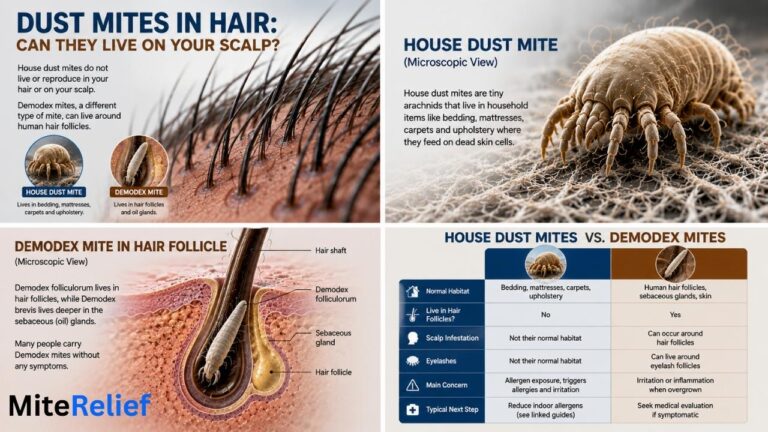
This is where the real story about mites and hair begins. Demodex mites are not house dust mites. They are an entirely separate type of mite that lives on human skin.
Two main types live on people. One is Demodex folliculorum. The other is Demodex brevis. Demodex folliculorum tends to live inside hair follicles.
These are the tiny pockets in your skin that each strand of hair grows from. Demodex brevis prefers the sebaceous glands instead.
These are small glands attached to hair follicles. They make an oily substance called sebum, which helps keep your skin and hair moisturized.
Here’s something that might surprise you. Many healthy adults carry Demodex mites without ever noticing.
Research suggests these mites are very common, and they tend to become more common as people get older. Most of the time, they cause no symptoms.
Having them is not unusual. It also does not automatically mean something is wrong.
Having Demodex mites is not the same as having house dust mites in your hair.
Sometimes, mite numbers rise above normal. The skin can also become inflamed. When that happens, symptoms may develop.
This condition is called demodicosis. It can involve itching, redness, or irritation. This isn’t typical for most people who carry these mites, though.
Demodicosis is its own topic. This article won’t cover its diagnosis or treatment in depth. A dermatologist is the right person to ask about that.
House Dust Mites vs. Demodex Mites
| Feature | House Dust Mites | Demodex Mites |
| Normal habitat | Bedding, carpets, upholstery | Human hair follicles and skin |
| Live in hair follicles? | No | Yes |
| Eyelashes | Not a normal habitat | Can live around lash follicles |
| Main concern | Allergens | Irritation or inflammation if numbers grow |
| Scalp infestation | Not normal | Can occur around follicles |
| Next step | Reduce indoor allergens | Medical assessment if symptomatic |
Can Dust Mites Live on Your Eyelashes?
Are you worried about dust mites on eyelashes? You can put that worry to rest. House dust mites are not the mites usually linked to eyelash problems.
Demodex mites can live around eyelash follicles. Sometimes their numbers increase. The eyelid can also become irritated.
This can lead to a condition called blepharitis. That’s inflammation along the eyelid edge.
What are the signs of eyelid irritation linked to Demodex? They may include:
- Itching around the lash line
- Redness or irritation
- Crusty debris at the base of the lashes
- General eyelid irritation
Do these signs sound familiar and won’t go away? See an eye-care professional instead of trying to manage it yourself.
Don’t diagnose or treat this at home. Eyelid skin is thin and sensitive, so it’s best left to someone trained to check it properly.
Can Dust Mites Cause Hair Loss?
It’s easy to connect hair loss with mites. But let’s be clear. House dust mites do not normally live on the scalp. There’s also no strong evidence they directly cause hair loss.
Hair loss has many possible causes, including genetics, hormones, nutrition, and certain scalp or skin conditions.
Pillow allergens haven’t been shown to cause hair shedding directly. So it wouldn’t be fair to blame them.
Some skin and scalp conditions do involve inflammation. Inflammation can sometimes affect hair indirectly.
But this is complicated. It also varies a lot from person to person. Are you noticing sudden, patchy, or ongoing hair loss? That’s worth bringing to a dermatologist.
It’s not something to sort out on your own.
Scalp Symptoms After Sleeping
Does your scalp feel itchier after a night’s sleep? Allergen exposure in your bedroom could be a factor.
This is especially true if you’re sensitive to dust mite allergens. A few simple steps can help lower that exposure:
- Wash pillowcases and bedding regularly.
- Consider allergen-proof pillow protection.
- Reduce dust buildup in the bedroom.
- Keep indoor humidity in check.
These steps focus on cutting down allergen exposure. They are not about trying to “remove” mites from your hair.
Dust mites don’t live there in the first place. A cleaner bedroom can still make a real difference in how your scalp and skin feel each morning.
Want more detail on pillow choices? Best pillow for dust mite allergy and best bedding for dust mite allergies both go deeper on that topic.
When to See a Dermatologist
Most scalp itching clears up with basic care. It usually doesn’t need urgent attention.
But some signs are worth getting checked out, since they can point to something that needs a closer look.
See a dermatologist if you notice persistent scalp itching. The same goes for severe redness, painful inflammation, or sores.
Heavy scaling is another sign to watch for. So are symptoms that don’t improve with normal scalp care.
Sudden or patchy hair loss also deserves a professional look, since it can have several different causes.
Do you have ongoing eyelid or eyelash symptoms? An eye-care professional is the better choice for those.
They can properly check for blepharitis or other causes of irritation.
FAQs
Do dust mites get in your hair?
A mite, or trace amounts of dust mite allergens, may briefly land on your hair. But that’s different from living or reproducing there. House dust mites don’t set up a lasting presence in human hair.
Can you feel dust mites crawling in your hair?
Feeling itchy or a crawling sensation doesn’t confirm that mites are present. These sensations can come from dry skin, scalp irritation, or other common scalp conditions. Itching alone doesn’t prove a mite infestation.
What mites actually live in human hair?
Demodex mites are the ones that live around human hair follicles, not house dust mites. Demodex folliculorum and Demodex brevis are the two types commonly found on human skin.
Are dust mites and Demodex mites the same?
No, they are completely different mites. House dust mites live in household dust and bedding. Demodex mites live on human skin and around hair follicles.
Can dust mites cause itchy scalp at night?
For people sensitive to dust mite allergens, bedroom exposure may add to itching. That said, this points to an allergic reaction. It does not mean mites are actually living in the scalp.
How do I get dust mites out of my hair?
You don’t need to remove dust mites from your hair, since they don’t live there in the first place. Is dust mite allergy your real concern? Instead, focus on cutting allergen exposure in your bedding and bedroom. That’s where the real problem usually lives.
What to Read Next:
- Do Dust Mites Bite? Rash, Symptoms & Real Causes
- Dust Mite Allergy Symptoms: Signs You Shouldn’t Ignore
- Eczema From Dust Mites: Signs, Triggers and Flares
- Best Pillow for Dust Mite Allergy
Conclusion
House dust mites are mainly an indoor allergen problem. They live in bedding, carpets, and upholstery, not in your hair.
Demodex mites are the ones actually linked to human hair follicles. That includes follicles around the scalp and eyelashes.
Do you have scalp or hair symptoms that won’t go away? It’s worth getting a proper evaluation. Don’t just assume a dust mite infestation is the cause.
A quick check with a professional can save you time and point you toward what’s actually going on.
Medical Disclaimer
This content is for general informational purposes only and is not a substitute for professional medical advice, diagnosis, or treatment. Individual health needs can vary, so speak with a qualified healthcare professional about allergies, asthma, skin reactions, medications, or other symptoms. Seek prompt medical care if symptoms are severe, persistent, or getting worse.

Umar Farooq is the founder of MiteRelief, a resource for dust mite control and allergy prevention. After battling allergen sensitivity, he started creating research-backed guides that turn complex indoor air quality science into practical, affordable solutions anyone can implement.