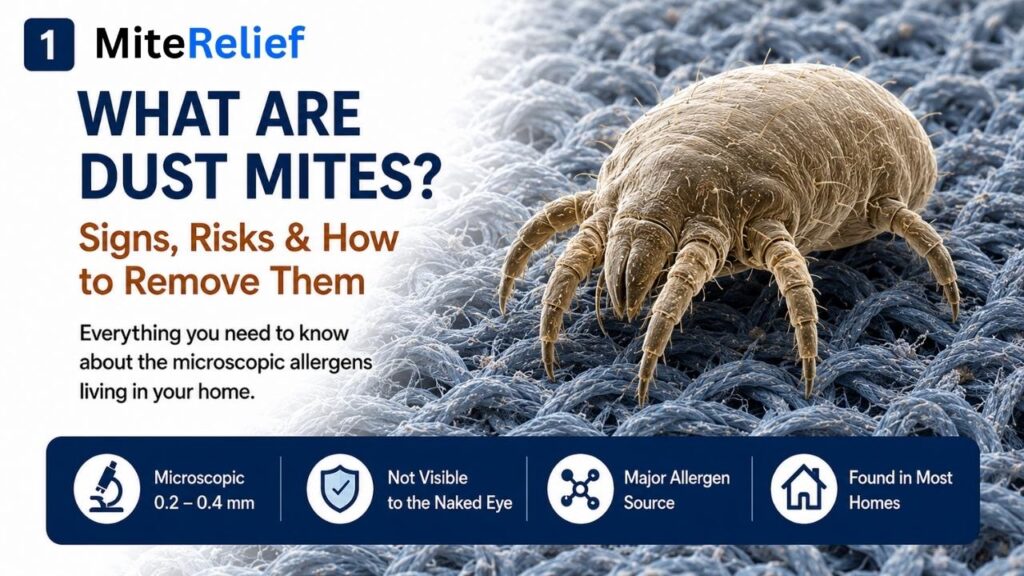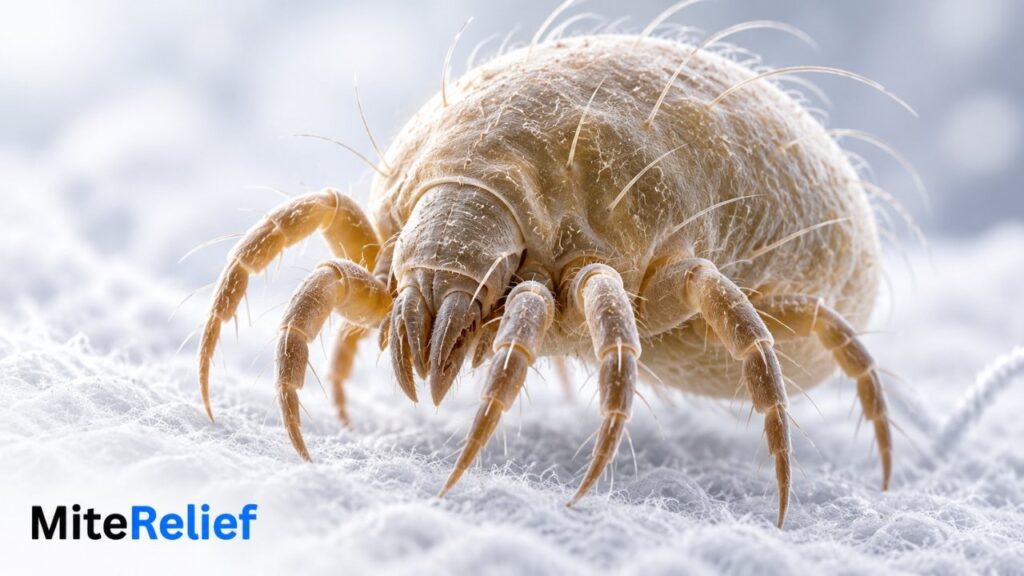
Storage mites vs. dust mites is a common question, and the short answer is no: they are not the same. Both belong to the broader mite group called Acari, and certain species from each group can cause allergic sensitization. But they belong to different families, live in different places, and eat different foods.
House dust mites live mostly in beds, carpets, and couches. Storage mites live mostly in stored grain, flour, dry foods, and animal feed. This guide explains how they differ, where each lives, and how to lower your exposure safely.
How Are Storage Mites Different From House Dust Mites?
House dust mites belong to the family Pyroglyphidae. The best-known ones are Dermatophagoides pteronyssinus, Dermatophagoides farinae, and Euroglyphus maynei. You can read more about common house dust mite species in our species guide.
Storage mites belong to several families, including Acaridae and Glycyphagidae. Common examples include Acarus siro, Tyrophagus putrescentiae, Glycyphagus domesticus, and Lepidoglyphus destructor.
Storage mites belong to several families, including Acaridae and Glycyphagidae. Common examples include Acarus siro, Tyrophagus putrescentiae, Glycyphagus domesticus, and Lepidoglyphus destructor.
Their food differs too. House dust mites feed mainly on shed human skin and other organic debris. Storage mites feed on different types of stored organic material, depending on the species. Their food sources may include grains, flour, animal feed, and associated microorganisms such as fungi.
Size is another clue. House dust mites are about 0.1 to 0.4 mm long, while storage mites can reach about 0.6 mm. Both are still nearly impossible to see without a microscope.
For a deeper look at the science, see this review on the biology of house dust mites and storage mites.
| Feature | House dust mites | Storage mites |
| Common habitat | Bedding, carpets, upholstery | Stored grains, foods, animal feed; sometimes indoor dust |
| Example species | D. pteronyssinus, D. farinae | Acarus siro, T. putrescentiae |
| Food sources | Shed skin and related organic material | Stored organic material and microbes, depending on species |
| Allergy relevance | Common indoor allergens | Occupational and other allergic sensitization |
| Control focus | Bedding, dust, humidity | Dry storage, moisture control, affected products |
Are Grain Mites a Type of Storage Mite?
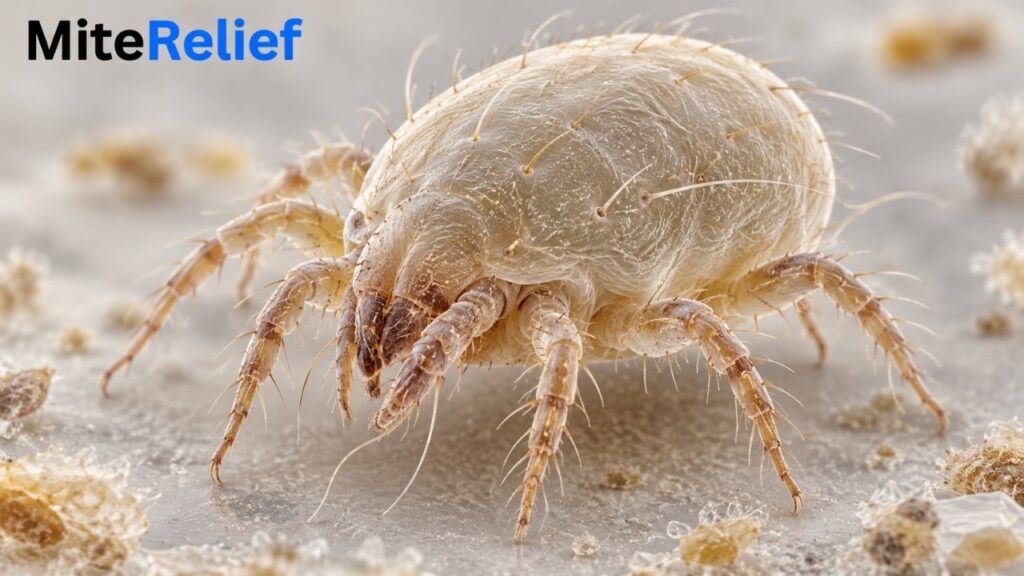
Yes. Grain mites are part of the storage-mite group. Acarus siro is a classic example, and it is often found in grain, flour, and similar foods.
Grain mites are not house dust mites. They have different food needs and live in different places. If you are comparing dust mites vs. grain mites, think “food storage” for one and “bedding and soft furniture” for the other.
Some readers also ask about mold mites. Our guide to dust mites, mold mites, and grain mites covers that full comparison so that we won’t repeat it here.
Where Do Storage Mites Live?

Storage mites live where you store food. That includes grains, flour, cereals, dry foods, and animal feed. They also like places where mold can grow. Because mold tends to grow in damp spots, storage mites are more likely to show up there too.
Moisture is the key. Like all mites, they lose water through their thin skin. They need enough humidity to survive and multiply. A cool, dry pantry is a much harder place for them to thrive than a warm, damp one.
Storage time matters as well. Food that sits for months in a humid spot has more time for problems to build.
Storage mites are not limited to food. German research found allergy-relevant storage mites in both farm work areas and city homes. So they can also occur in household dust. We don’t know how common this is in every US home.
Can Storage Mites Cause Allergies?

Yes. Storage mites have high allergenic potential. Like house dust mites, they can lead to sensitization through the formation of specific IgE antibodies. That means the immune system learns to react to mite allergens.
About 150 storage mite species are known, but only about 20 matter for allergies. So not every mite you find is an allergy risk.
Cross-reactivity is also possible. Allergens from different mites can look similar to the immune system. As a result, someone sensitized to one type of mite may react to another. How much this affects any one person varies.
People who work around grain, feed, or hay may have more contact with storage mites. Symptoms can include a runny nose, sneezing, and, for some people, asthma-like symptoms.
Sensitization does not prove that a mite is causing your symptoms. A test can show an immune response, but a doctor must match it to your real-life exposure.
Rarely, eating food heavily contaminated with mites has caused severe reactions. This is called oral mite anaphylaxis, and it is not a common concern for most people.
Can Storage Mites Get Into Pet Food?
They can. Storage mites like feed, so dry pet food and animal feed can become a home for them when stored in warm, damp conditions. That does not mean every bag contains mites. Most problems start with how you store food, not the product itself.
Open bags are the biggest risk. Once a bag is open, moisture can creep in. A bag kept in a humid garage or a warm kitchen corner is more likely to have trouble than one kept in a cool, dry spot.
Research has detected storage mites in some commercial dry dog foods, particularly under suitable storage conditions. However, findings from controlled experiments should not be interpreted as evidence that every commercial pet food product contains mites.
Pets can have allergies too, and they can be tied to mites. Our guide on dust mite allergies in dogs and cats covers that topic. Discuss storage mites in dogs with a veterinarian.
How to Reduce Storage-Mite Exposure

Mites are very adaptable, so removing them completely is hard. The goal is to make storage less friendly to them.
- Keep it dry. Store food and feed in a cool, dry place. Avoid damp basements, garages, and spots near sinks.
- Use sealed containers. Airtight containers help keep moisture and new mites out. Move opened flour, grains, and pet food into them.
- Buy smaller amounts. Food that sits less has less time to go bad.
- Check your products. Look at stored items now and then. Musty smells, clumping, or odd dust on the surface are warning signs.
- Toss spoiled items. If a product seems affected, follow food and feed safety guidance. When in doubt, throw it out.
- Clean the storage area. Wipe shelves and containers and let them dry fully before refilling.
Do not spray pesticides directly on food or feed. It is not a safe fix.
Frequently Asked Questions (FAQs)
Can storage mites live in household dust?
Yes, some can. Research has found allergy-relevant storage mites in city homes and in farm work areas. They are usually linked to stored food, though. House dust mites are more common in beds and carpets.
Do storage mites bite humans?
Storage mites are not usually described as biting mites. The main health concern in the research is allergy, not bites. If you have an itchy rash, a doctor can help find the real cause.
Can you see storage mites without a microscope?
Usually not. Storage mites reach only about 0.6 mm, which is practically invisible to the naked eye. A buildup may look like fine dust, but dust alone doesn’t confirm mites. Identification needs a microscope.
Are storage mite allergies the same as dust mite allergies?
They are similar but not identical. Both involve IgE antibodies, and cross-reactivity is possible. The main difference is where exposure happens. Storage mite exposure often involves food and feed, which is why storage mites in humans are often tied to certain jobs.
When should you seek allergy testing?
Consider testing if symptoms are persistent, keep coming back, or get worse. This matters most if you work around grain or feed. An allergist can test you and explain the results.
What to Read Next
- Dust Mites vs Mold Mites: Key Differences
- House Dust Mite Species Guide
- Foods to Avoid With Dust Mite Allergy
Conclusion
Storage mites vs dust mites comes down to where they live and what they eat. House dust mites favor bedding, carpets, and skin flakes. Storage mites favor grain, feed, and damp stored food. Both can trigger allergies, and their allergens can overlap.
Dust control and humidity matter most for house dust mites. Dry, sealed, well-checked storage matters most for storage mites. If symptoms keep coming back, talk with an allergist.
Medical Disclaimer
This content is for general informational purposes only and is not a substitute for professional medical advice, diagnosis, or treatment. Individual health needs can vary, so speak with a qualified healthcare professional about allergies, asthma, skin reactions, medications, or other symptoms. Seek prompt medical care if symptoms are severe, persistent, or getting worse.

Umar Farooq is the founder of MiteRelief, creating research-backed guides about dust mites, indoor allergens, and practical allergy prevention for healthier homes.